Getting Started with React Data Grid in Preact Framework
This article provides a step-by-step guide for setting up a Preact project and integrating the Syncfusion® React Data Grid component.
Preact is a fast and lightweight JavaScript library for building user interfaces. It’s often used as an alternative to larger frameworks like React. The key difference is that Preact is designed to be smaller in size and faster in performance, making it a good choice for projects where file size and load times are critical factors.
Prerequisites
- React: Use React version 15.5.4 or higher.
- Node.js: Use Node.js version 14.0.0 or above.
- Yarn (optional): If using Yarn, ensure Yarn version >= 0.25.
Set up the Preact project
Create a new Preact project using the initialization command:
npm init preactor
yarn init preactUsing one of the above commands will lead you to set up additional configurations for the project, as below:
Project name
Specify the project name as my-project.
T  Preact - Fast 3kB alternative to React with the same modern API
|
*  Project directory:
|  my-project
—
Project language
Choose JavaScript as the framework variant to build this Preact project using JavaScript and React.
T  Preact - Fast 3kB alternative to React with the same modern API
|
*  Project language:
|  > JavaScript
|    TypeScript
—
Configuration options
Respond to the following prompts with the default selections:
T  Preact - Fast 3kB alternative to React with the same modern API
|
*  Use router?
|    Yes / > No
—
|
*  Prerender app (SSG)?
|    Yes / > No
—
|
*  Use ESLint?
|    Yes / > No
—
Navigate to project
Once setup is complete, navigate to your project directory:
cd my-projectNow that my-project is ready to run with default settings, let’s add Syncfusion® components to the project.
Adding Syncfusion® React Grids package
Syncfusion® React component packages are available on npmjs.com. This article uses the React Data Grid component as an example. To use the React Data Grid component in the project, the @syncfusion/ej2-react-grids package needs to be installed using the following command:
npm install @syncfusion/ej2-react-grids --saveor
yarn add @syncfusion/ej2-react-gridsBefore including Syncfusion styles, make sure to remove the default styles defined in index.css. This helps prevent unintended style overrides and ensures that Syncfusion components render correctly.
Adding CSS reference
Themes for Syncfusion® Data Grid component can be applied using CSS files provided through npm theme packages. For available themes, refer to the Themes documentation.
Install the Material 3 theme package using the following command:
npm install @syncfusion/ej2-material3-theme --saveThen add the following CSS reference to the src/App.css file:
@import '../node_modules/@syncfusion/ej2-material3-theme/styles/grid/index.css';Adding Data Grid component
The Data Grid code should be added to the src/index.jsx file.
import { render } from 'preact';
import { ColumnDirective, ColumnsDirective, GridComponent } from '@syncfusion/ej2-react-grids';
import './style.css';

export function App() {
  // Defines the data to be displayed in the Data Grid.
  const data = [
    { OrderID: 10248, CustomerID: 'VINET', EmployeeID: 5, ShipCountry: 'France', Freight: 32.38 },
    { OrderID: 10249, CustomerID: 'TOMSP', EmployeeID: 6, ShipCountry: 'Germany', Freight: 11.61 },
    { OrderID: 10250, CustomerID: 'HANAR', EmployeeID: 4, ShipCountry: 'Brazil', Freight: 65.83 }
  ];

  return (
    {/* Assigns the dataset to the Data Grid component */}
    <GridComponent dataSource={data}>
      {/* Define the columns to be displayed */}
      <ColumnsDirective>
        <ColumnDirective field='OrderID' width='100' textAlign="Right" />
        <ColumnDirective field='CustomerID' width='100' />
        <ColumnDirective field='EmployeeID' width='100' textAlign="Right" />
        <ColumnDirective field='Freight' width='100' format="C2" textAlign="Right" />
        <ColumnDirective field='ShipCountry' width='100' />
      </ColumnsDirective>
    </GridComponent>
  );
}

render(<App />, document.getElementById('app'));
Run the project
npm run devor
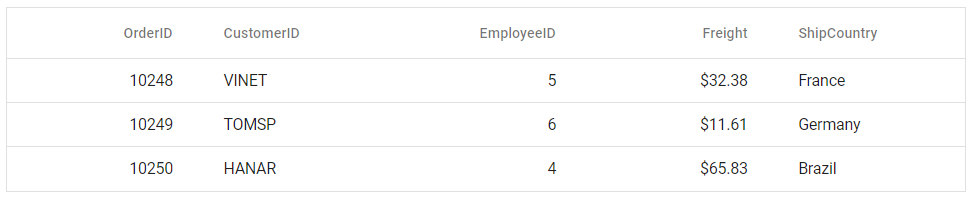
yarn run devThe output will appear as follows: