How can I help you?
Getting Started with the Vue Dropdown Tree Component in Vue 3
7 Feb 20269 minutes to read
This article provides a step-by-step guide for setting up a Vite project with a JavaScript environment and integrating the Syncfusion® Vue Dropdown Tree component using the Composition API / Options API.
The Composition API is a new feature introduced in Vue.js 3 that provides an alternative way to organize and reuse component logic. It allows developers to write components as functions that use smaller, reusable functions called composition functions to manage their properties and behavior.
The Options API is the traditional way of writing Vue.js components, where the component logic is organized into a series of options that define the component’s properties and behavior. These options include data, methods, computed properties, watchers, lifecycle hooks, and more.
Prerequisites
System requirements for Syncfusion® Vue UI components
Setup the Vite project
A recommended approach for beginning with Vue is to scaffold a project using Vite. To create a new Vite project, use one of the commands that are specific to either NPM or Yarn.
npm create vite@latestor
yarn create viteUsing one of the above commands will lead you to set up additional configurations for the project as below:
1.Define the project name: The name of the project can be specified directly. For this article, the project name is set as my-project.
? Project name: » my-project2.Select Vue as the framework. It will create a Vue 3 project.
? Select a framework: » - Use arrow-keys. Return to submit.
Vanilla
> Vue
  React
  Preact
  Lit
  Svelte
  Others
3.Choose JavaScript as the framework variant to build this Vite project using JavaScript and Vue.
? Select a variant: » - Use arrow-keys. Return to submit.
> JavaScript
  TypeScript
  Customize with create-vue ↗
  Nuxt ↗
4.Rolldown is Vite’s new experimental faster bundler (rust-based, replacing rollup). Choose No uses the stable, proven rollup-based Vite (recommended for most users)
Use rolldown-vite (Experimental)? No5.Install dependencies and start the dev server.
Install with npm and start now?: YesSince you selected Yes, the development server should start automatically. If you selected No, please follow these steps to set up and start the project manually:
cd my-project
npm install
or
cd my-project
yarn install
Now that my-project is ready to run with default settings, let’s add Syncfusion® components to the project.
Add Syncfusion® Vue packages
Syncfusion® Vue component packages are available at npmjs.com. To use Syncfusion® Vue components in the project, install the corresponding npm package.
This article uses the Vue Dropdown Tree component as an example. To use the Vue Dropdown Tree component in the project, the @syncfusion/ej2-vue-navigations package needs to be installed using the following command:
npm install @syncfusion/ej2-vue-dropdowns --saveor
yarn add @syncfusion/ej2-vue-dropdownsImport Syncfusion® CSS styles
You can import themes for the Syncfusion® Vue component in various ways, such as using CSS or SASS styles from npm packages, CDN, CRG and Theme Studio. Refer to themes topic to know more about built-in themes and different ways to refer to themes in a Vue project.
In this article, Material3 theme is applied using CSS styles, which are available in installed packages. The necessary Material3 CSS styles for the Dropdown Tree component and its dependents were imported into the <style> section of src/App.vue file.
<style>
  @import "../node_modules/@syncfusion/ej2-base/styles/material3.css";
  @import "../node_modules/@syncfusion/ej2-inputs/styles/material3.css";
  @import "../node_modules/@syncfusion/ej2-navigations/styles/material3.css";
  @import "../node_modules/@syncfusion/ej2-vue-dropdowns/styles/material3.css";
</style>
Add Syncfusion® Vue component
Follow the below steps to add the Vue Dropdown Tree component using Composition API or Options API:
1.First, import and register the Dropdown Tree component in the script section of the src/App.vue file. If you are using the Composition API, you should add the setup attribute to the script tag to indicate that Vue will be using the Composition API.
<script setup>
  import { DropDownTreeComponent as EjsDropdowntree } from "@syncfusion/ej2-vue-dropdowns";
</script><script>
import { DropDownTreeComponent } from "@syncfusion/ej2-vue-dropdowns";
//Component registration
export default {
name: "App",
components: {
"ejs-dropdowntree": DropDownTreeComponent
}
}
</script>2.Add the component definition in template section.
<template>
  <ejs-dropdowntree id='dropdowntree' :fields='fields'></ejs-dropdowntree>
</template>
Here is the summarized code for the above steps in the src/App.vue file:
<template>
  <ejs-dropdowntree id='dropdowntree' :fields='fields'></ejs-dropdowntree>
</template>

<script setup>
  import { DropDownTreeComponent as EjsDropdowntree } from "@syncfusion/ej2-vue-dropdowns";

  const data =  [
    {
      nodeId: '01', nodeText: 'Music',
      nodeChild: [
        { nodeId: '01-01', nodeText: 'Gouttes.mp3' }
      ]
    },
    {
      nodeId: '02', nodeText: 'Videos', expanded: true,
      nodeChild: [
        { nodeId: '02-01', nodeText: 'Naturals.mp4' },
        { nodeId: '02-02', nodeText: 'Wild.mpeg' },
      ]
    },
    {
      nodeId: '03', nodeText: 'Documents',
      nodeChild: [
        { nodeId: '03-01', nodeText: 'Environment Pollution.docx' },
        { nodeId: '03-02', nodeText: 'Global Water, Sanitation, & Hygiene.docx' },
        { nodeId: '03-03', nodeText: 'Global Warming.ppt' },
        { nodeId: '03-04', nodeText: 'Social Network.pdf' },
        { nodeId: '03-05', nodeText: 'Youth Empowerment.pdf' },
    ]
  }];
  const fields = { dataSource: data, value: 'nodeId', text: 'nodeText', child: 'nodeChild' };
</script>

<style>
  @import "../node_modules/@syncfusion/ej2-base/styles/material3.css";
  @import "../node_modules/@syncfusion/ej2-inputs/styles/material3.css";
  @import "../node_modules/@syncfusion/ej2-navigations/styles/material3.css";
  @import "../node_modules/@syncfusion/ej2-vue-dropdowns/styles/material3.css";
</style><template>
<ejs-dropdowntree id='dropdowntree' :fields='fields'></ejs-dropdowntree>
</template>
<script>
import { DropDownTreeComponent } from "@syncfusion/ej2-vue-dropdowns";
const data = [
{
nodeId: '01', nodeText: 'Music',
nodeChild: [
{ nodeId: '01-01', nodeText: 'Gouttes.mp3' }
]
},
{
nodeId: '02', nodeText: 'Videos', expanded: true,
nodeChild: [
{ nodeId: '02-01', nodeText: 'Naturals.mp4' },
{ nodeId: '02-02', nodeText: 'Wild.mpeg' },
]
},
{
nodeId: '03', nodeText: 'Documents',
nodeChild: [
{ nodeId: '03-01', nodeText: 'Environment Pollution.docx' },
{ nodeId: '03-02', nodeText: 'Global Water, Sanitation, & Hygiene.docx' },
{ nodeId: '03-03', nodeText: 'Global Warming.ppt' },
{ nodeId: '03-04', nodeText: 'Social Network.pdf' },
{ nodeId: '03-05', nodeText: 'Youth Empowerment.pdf' },
]
}];
//Component registration
export default {
name: "App",
components: {
"ejs-dropdowntree": DropDownTreeComponent
},
data() {
return {
fields: { dataSource: data, value: 'nodeId', text: 'nodeText', child: 'nodeChild' }
};
}
}
</script>
<style>
@import "../node_modules/@syncfusion/ej2-base/styles/material3.css";
@import "../node_modules/@syncfusion/ej2-inputs/styles/material3.css";
@import "../node_modules/@syncfusion/ej2-navigations/styles/material3.css";
@import "../node_modules/@syncfusion/ej2-vue-dropdowns/styles/material3.css";
</style>Run the project
To run the project, use the following command:
npm run devor
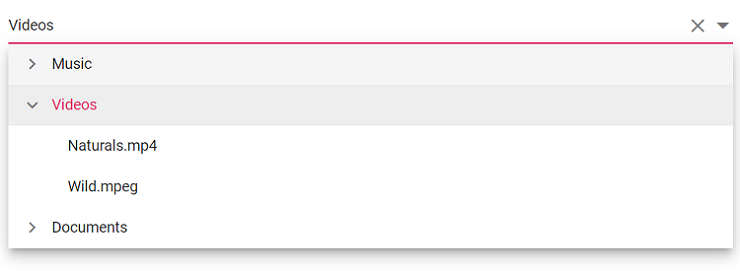
yarn run devThe output will appear as follows:
For migrating from Vue 2 to Vue 3, refer to the migration documentation.