SQL Server Dapper Integration in React Data Grid
The React Data Grid supports binding data from SQL Server using the lightweight Dapper micro‑ORM. This modern approach provides a simpler, more direct alternative where raw SQL control is preferred.
What is Dapper?
Dapper is a lightweight, high-performance ORM (Object-Relational Mapper) that provides a minimal abstraction over ADO.NET. It maps query results directly to C# objects with minimal overhead, making it ideal for applications where performance and control over SQL are critical.
Key benefits of Dapper
- High Performance: Minimal overhead with direct ADO.NET access, resulting in faster query execution.
- SQL Control: Write raw SQL queries when needed, giving developers full control over database operations.
- Simple and Lightweight: Requires minimal configuration and learning curve compared to full ORMs.
- Flexible Mapping: Automatically maps query results to objects with minimal configuration.
- Built-in Security: Parameterized queries prevent SQL injection attacks.
Prerequisites
Ensure the following software and packages are installed before proceeding:
| Software/Package | Version | Purpose |
|---|---|---|
| Visual Studio | 2022 or later | Development IDE with React and ASP.NET Core workload |
| .NET SDK | .NET 10.0 or later | Runtime and build tools for backend API |
| Node.js | 18.x or later | JavaScript runtime for React development |
| SQL Server | 2019 or later | Database server |
| Dapper | 2.1.66 or later | Lightweight micro-ORM for SQL mapping |
Key topics
| # | Topics | Link |
|---|---|---|
| 1 | Create a SQL Server database with reservation records | View |
| 2 | Install necessary NuGet packages for Dapper and Syncfusion | View |
| 3 | Create data models for database mapping | View |
| 4 | Configure connection strings for SQL Server | View |
| 5 | Implement the repository pattern with Dapper for efficient data access | View |
| 6 | Create a React Grid component that supports searching, filtering, sorting, paging, and CRUD operations | View |
| 7 | Handle bulk operations and batch updates | View |
| 8 | Complete end‑to‑end reservation management workflow using the Syncfusio®n React Grid with server‑side processing and SQL Server integration | View |
| 9 | Explore a complete working sample available on GitHub | View |
Setting up the SQL Server environment with Dapper
The API service relies on an existing SQL Server database containing a table. Within this documentation, a “Rooms” table is introduced to support hotel reservation management.
Step 1: Create the Database and table in SQL Server
First, the SQL Server database structure must be created to store reservation records.
Instructions:
- Open SQL Server Management Studio or any SQL Server client.
- Create a new database named “HotelBookingDB”.
- Define a “Rooms” table with the specified schema.
- Insert sample data for testing.
Run the following SQL script:
-- Create Database if it doesn't exist
IF NOT EXISTS (SELECT 1 FROM sys.databases WHERE name = N'HotelBookingDB')
BEGIN
    CREATE DATABASE HotelBookingDB;
END
GO

USE HotelBookingDB;
GO

-- Create Rooms table if it doesn't exist
IF NOT EXISTS (SELECT 1 FROM sys.tables WHERE name = N'Rooms' AND schema_id = SCHEMA_ID(N'dbo'))
BEGIN
    CREATE TABLE dbo.Rooms (
        Id INT IDENTITY(1,1) PRIMARY KEY,
        ReservationId VARCHAR(50) NOT NULL,
        GuestName VARCHAR(100) NOT NULL,
        GuestEmail VARCHAR(250) NULL,
        CheckInDate DATE NOT NULL,
        CheckOutDate DATE NULL,
        RoomType VARCHAR(100) NULL,
        RoomNumber VARCHAR(20) NULL,
        AmountPerDay DECIMAL(18,2) NULL,
        NoOfDays INT NULL,
        TotalAmount DECIMAL(18,2) NULL,
        PaymentStatus VARCHAR(50) NOT NULL,
        ReservationStatus VARCHAR(50) NOT NULL
    );
END
GO

-- Insert Sample Data (Optional).
IF NOT EXISTS (SELECT 1 FROM dbo.Rooms WHERE ReservationId IN (N'RES001001', N'RES001002'))
BEGIN
    INSERT INTO dbo.Rooms
        (ReservationId, GuestName, GuestEmail, CheckInDate, CheckOutDate, RoomType, RoomNumber, AmountPerDay, NoOfDays, TotalAmount, PaymentStatus, ReservationStatus)
    VALUES
        (N'RES001001', N'John Doe', N'[email protected]', '2026-01-13', '2026-01-15', N'Deluxe Suite', N'D-204', 150.00, 2, 300.00, N'Paid', N'Confirmed'),
        (N'RES001002', N'Mary Smith', N'[email protected]', '2026-01-14', '2026-01-17', N'Standard Room', N'S-108', 90.00, 3, 270.00, N'Pending', N'Confirmed');
END
GO
After executing this script, the reservation records are stored in the “Rooms” table within the “HotelBookingDB” database. The database is now ready for integration with the React application.
Step 2: Create a new ASP.NET Core project
Before installing NuGet packages, a new ASP.NET Core Web Application must be created.
Instructions:
- Open Visual Studio 2022.
- Click Create a new project.
- Search for ASP.NET Core Web API.
- Select the template and click Next.
- Configure the project:
- Project name: Grid_Dapper.Server (or a preferred name)
- Location: Choose the desired folder
- Framework: Select .NET 10.0 (or latest available)
- Click Create.
Visual Studio will create the project with the default structure, including folders like Controllers and configuration files. The ASP.NET Core project is now ready for integration with Dapper and Syncfusion® components.
Step 3: Install required NuGet packages
NuGet packages are software libraries that add functionality to the application. These packages enable Dapper, SQL Server connectivity, and Syncfusion Grid integration.
Method 1: Using Package Manager Console
- Open Visual Studio.
- Navigate to Tools → NuGet Package Manager → Package Manager Console.
- Run the following commands:
Install-Package Microsoft.Data.SqlClient
Install-Package Dapper
Install-Package Syncfusion.EJ2.AspNet.Core
Method 2: Using NuGet Package Manager UI
- Open Visual Studio → Tools → NuGet Package Manager → Manage NuGet Packages for Solution.
- Search for and install each package individually:
- Microsoft.Data.SqlClient
- Dapper
- Syncfusion.EJ2.AspNet.Core
All required packages are now installed.
Step 4: Create the data model
A data model is a C# class that represents the structure of a database table. This model defines the properties that correspond to the columns in the Rooms table.
Instructions:
- Create a new folder named Data in the ASP.NET Core project.
- Inside the Data folder, create a new file named Reservation.cs.
- Define the “Reservation” class with the following code:
using System.ComponentModel.DataAnnotations;

namespace Grid_Dapper.Server.Data
{
    /// <summary>
    /// Represents a reservation record mapped to the 'Rooms' table in the database.
    /// This model defines the structure of reservation-related data used throughout the application.
    /// </summary>
    public class Reservation
    {
        /// <summary>
        /// Gets or sets the unique identifier for the reservation record.
        /// </summary>
        [Key]
        public int Id { get; set; }

        /// <summary>
        /// Gets or sets the unique reservation reference generated by the system.
        /// </summary>
        public string? ReservationId { get; set; }

        /// <summary>
        /// Gets or sets the name of the guest making the reservation.
        /// </summary>
        public string? GuestName { get; set; }

        /// <summary>
        /// Gets or sets the email address of the guest.
        /// </summary>
        public string? GuestEmail { get; set; }

        /// <summary>
        /// Gets or sets the check-in date for the reservation.
        /// </summary>
        public DateTime? CheckInDate { get; set; }

        /// <summary>
        /// Gets or sets the check-out date for the reservation.
        /// </summary>
        public DateTime? CheckOutDate { get; set; }

        /// <summary>
        /// Gets or sets the type of room (e.g., Standard, Deluxe, Suite).
        /// </summary>
        public string? RoomType { get; set; }

        /// <summary>
        /// Gets or sets the room number assigned to the reservation.
        /// </summary>
        public string? RoomNumber { get; set; }

        /// <summary>
        /// Gets or sets the cost per day for the room.
        /// </summary>
        public decimal? AmountPerDay { get; set; }

        /// <summary>
        /// Gets or sets the number of days for the stay (calculated from check-in and check-out dates).
        /// </summary>
        public int? NoOfDays { get; set; }

        /// <summary>
        /// Gets or sets the total amount for the reservation (calculated as AmountPerDay × NoOfDays).
        /// </summary>
        public decimal? TotalAmount { get; set; }

        /// <summary>
        /// Gets or sets the payment status (e.g., Pending, Paid, Failed).
        /// </summary>
        public string? PaymentStatus { get; set; }

        /// <summary>
        /// Gets or sets the reservation status (e.g., Confirmed, Cancelled, Completed).
        /// </summary>
        public string? ReservationStatus { get; set; }
    }
}
Explanation:
- The
[Key]attribute marks the “Id” property as the primary key (a unique identifier for each record). - Each property represents a column in the database table.
- The
?symbol indicates that a property is nullable (can be empty). - XML documentation comments describe each property’s purpose.
The data model has been successfully created.
Step 5: Configure the connection string
A connection string contains the information needed to connect the application to the SQL Server database, including the server address, database name, and credentials.
Instructions:
- Open the appsettings.json file in the project root.
- Add or update the
ConnectionStringssection with the SQL Server connection details:
{
  "Logging": {
    "LogLevel": {
      "Default": "Information",
      "Microsoft.AspNetCore": "Warning"
    }
  },
  "AllowedHosts": "*",
  "ConnectionStrings": {
    "HotelBookingDB": "Server=(localdb)\\MSSQLLocalDB;Database=HotelBookingDB;Trusted_Connection=True;TrustServerCertificate=True;"
  }
}
Connection string components:
| Component | Description |
|---|---|
| Server | The address of the SQL Server instance |
| Database | The database name (in this case, “HotelBookingDB”) |
| Trusted_Connection | Set to True for Windows Authentication; use False with Username/Password for SQL Authentication |
| TrustServerCertificate | Set to True to bypass certificate validation (suitable for local development) |
The database connection string has been configured successfully.
Step 6: Create the Repository Class
A repository class is an intermediary layer that handles all database operations. With Dapper, this class uses raw SQL queries executed through Dapper’s extension methods on IDbConnection, which automatically maps query results to C# objects.
Instructions:
- Inside the Data folder, create a new file named ReservationRepository.cs.
- Define the “ReservationRepository” class with the following code:
using Dapper;
using System.Data;

namespace Grid_Dapper.Server.Data
{
    /// <summary>
    /// Repository pattern implementation for Reservation using Dapper
    /// Handles CRUD operations for hotel room reservations
    /// </summary>
    public class ReservationRepository
    {
        private readonly IDbConnection _connection;

        // ReservationId configuration (matches samples like RES001001)
        private const string ReservationIdPrefix = "RES";
        private const int ReservationIdStartNumber = 1001;

        public ReservationRepository(IDbConnection connection)
        {
            _connection = connection;
        }

        /// <summary>
        /// Retrieves all reservations ordered by Id descending.
        /// </summary>
        public async Task<List<Reservation>> GetReservationsAsync()
        {
            const string sql = @"SELECT Id, ReservationId, GuestName, GuestEmail, CheckInDate, CheckOutDate,
                                         RoomType, RoomNumber, AmountPerDay, NoOfDays, TotalAmount,
                                         PaymentStatus, ReservationStatus
                                  FROM dbo.Rooms ORDER BY Id DESC";

            var result = await _connection.QueryAsync<Reservation>(sql);
            return result.ToList();
        }

        /// <summary>
        /// Generates the next ReservationId (e.g., RES001002) by reading the current max numeric suffix.
        /// </summary>
        private async Task<string> GenerateReservationIdAsync()
        {
            const string sql = @"
                SELECT MAX(TRY_CAST(SUBSTRING(ReservationId, LEN(@prefix) + 1, 50) AS INT))
                FROM dbo.Rooms
                WHERE ReservationId LIKE @like";

            var maxNumber = await _connection.ExecuteScalarAsync<int?>(sql, new
            {
                prefix = ReservationIdPrefix,
                like   = ReservationIdPrefix + "%"
            });

            int next = (maxNumber ?? (ReservationIdStartNumber - 1)) + 1;
            // Pad to 6 digits to match existing samples like RES001001
            return $"{ReservationIdPrefix}{next:D6}";
        }

        /// <summary>
        /// Inserts a new reservation and returns the created entity with generated Id.
        /// </summary>
        public async Task<Reservation> AddReservationAsync(Reservation value)
        {
            if (value == null) throw new ArgumentNullException(nameof(value));

            if (string.IsNullOrWhiteSpace(value.ReservationId))
                value.ReservationId = await GenerateReservationIdAsync();

            const string sql = @"
                INSERT INTO dbo.Rooms
                    (ReservationId, GuestName, GuestEmail, CheckInDate, CheckOutDate, RoomType, RoomNumber,
                     AmountPerDay, NoOfDays, TotalAmount, PaymentStatus, ReservationStatus)
                OUTPUT INSERTED.Id
                VALUES
                    (@ReservationId, @GuestName, @GuestEmail, @CheckInDate, @CheckOutDate, @RoomType, @RoomNumber,
                     @AmountPerDay, @NoOfDays, @TotalAmount, @PaymentStatus, @ReservationStatus)";

            value.Id = await _connection.ExecuteScalarAsync<int>(sql, value);
            return value;
        }

        /// <summary>
        /// Updates an existing reservation by Id and returns the updated entity.
        /// </summary>
        public async Task<Reservation> UpdateReservationAsync(Reservation value)
        {
            if (value == null) throw new ArgumentNullException(nameof(value));

            const string sql = @"
                UPDATE dbo.Rooms
                   SET ReservationId     = @ReservationId,
                       GuestName         = @GuestName,
                       GuestEmail        = @GuestEmail,
                       CheckInDate       = @CheckInDate,
                       CheckOutDate      = @CheckOutDate,
                       RoomType          = @RoomType,
                       RoomNumber        = @RoomNumber,
                       AmountPerDay      = @AmountPerDay,
                       NoOfDays          = @NoOfDays,
                       TotalAmount       = @TotalAmount,
                       PaymentStatus     = @PaymentStatus,
                       ReservationStatus = @ReservationStatus
                 WHERE Id = @Id";

            await _connection.ExecuteAsync(sql, value);
            return value;
        }

        /// <summary>
        /// Deletes a reservation by Id. Returns the number of affected rows (0 or 1).
        /// </summary>
        public async Task<int> RemoveReservationAsync(int id)
        {
            const string sql = @"DELETE FROM dbo.Rooms WHERE Id = @Id";
            return await _connection.ExecuteAsync(sql, new { Id = id });
        }
    }
}
Dapper extension methods:
| Method | Description |
|---|---|
QueryAsync<T> |
Executes a SQL SELECT and automatically maps each row to an instance of T by matching column names to property names. Returns IEnumerable<T>. |
ExecuteScalarAsync<T> |
Executes a SQL statement and returns the first column of the first row as type T (used for INSERT … OUTPUT INSERTED.Id and aggregate queries). |
ExecuteAsync |
Executes a SQL INSERT / UPDATE / DELETE statement and returns the number of affected rows. |
The repository class manages all interactions with the database and is now ready for implementation.
Step 7: Register services in Program.cs
The Program.cs file is where application services are registered and configured. This file must be updated to enable Dapper and the repository pattern.
Instructions:
- Open the Program.cs file at the project root.
- Add the following code:
using Grid_Dapper.Server.Data;
using System.Data;
using Microsoft.Data.SqlClient;
using Microsoft.AspNetCore.Http.Json;

var builder = WebApplication.CreateBuilder(args);

builder.Services.AddOpenApi();

// CORS: allow all (simple for local dev / separate frontend)
builder.Services.AddCors(options =>
{
    options.AddDefaultPolicy(policy => policy.AllowAnyOrigin().AllowAnyHeader().AllowAnyMethod());
});


// Controllers with System.Text.Json configured to KEEP PascalCase
builder.Services.AddControllers()
    .AddJsonOptions(o =>
    {
        // Keep property names as declared in C# (PascalCase)
        o.JsonSerializerOptions.PropertyNamingPolicy = null;
        // Keep dictionary keys as-is too
        o.JsonSerializerOptions.DictionaryKeyPolicy = null;
        // Allow case-insensitive reads (accept camelCase or PascalCase on input)
        o.JsonSerializerOptions.PropertyNameCaseInsensitive = true;
    });


// Get connection string from appsettings.json
var connectionString = builder.Configuration.GetConnectionString("HotelBookingDB");
if (string.IsNullOrEmpty(connectionString))
{
    throw new InvalidOperationException("Connection string 'HotelBookingDB' not found in configuration.");
}


// Register IDbConnection for Dapper
builder.Services.AddScoped<IDbConnection>(sp => new SqlConnection(connectionString));

// Register the repository for dependency injection
builder.Services.AddScoped<ReservationRepository>();

var app = builder.Build();

app.UseDefaultFiles();
app.MapStaticAssets();
app.UseCors();

// Configure the HTTP request pipeline.
if (app.Environment.IsDevelopment())
{
    app.MapOpenApi();
}

app.UseHttpsRedirection();

app.UseAuthorization();

app.MapControllers();

app.MapFallbackToFile("/index.html");

app.Run();
Explanation:
-
AddScoped<IDbConnection>: Registers aSqlConnectionas a scopedIDbConnectionservice. Dapper works directly againstIDbConnection, so each request receives its own connection instance injected intoReservationRepository. -
AddScoped<ReservationRepository>: Makes theReservationRepositoryavailable for dependency injection throughout the application. -
AddCors: Configures CORS to allow any origin, header, and method for local development with a separate React frontend. -
AddJsonOptions: ConfiguresSystem.Text.Jsonto preserve PascalCase property names, matching the C# model property names.
The service registration has been completed successfully.
Integrating Syncfusion React Grid
The React Data Grid is a robust, high‑performance component built to efficiently display, manage, and manipulate large datasets. It provides advanced features such as sorting, filtering, and paging. Follow these steps to render the grid and integrate it with a SQL Server database using Dapper.
Step 1: Creating the React client application
Open a Visual Studio Code terminal or Command Prompt and run the below command to create a React application:
npm create vite@latest grid_dapper.client
cd grid_dapper.client
Step 2: Adding Syncfusion packages
Install the necessary Syncfusion® packages using the below command in Visual Studio Code terminal or Command Prompt.
npm install @syncfusion/ej2-react-grids --save
npm install @syncfusion/ej2-data --save
After installation, the necessary CSS files are available in the (../node_modules/@syncfusion) directory. Add the required CSS references to the (src/index.css) file to ensure proper styling of the Grid component.
@import "../node_modules/@syncfusion/ej2-bootstrap5.3-theme/styles/grid/index.css";For this project, the “Bootstrap 5” theme is applied. Other themes can be selected, or the existing theme can be customized to meet specific project requirements. For detailed guidance on theming and customization, refer to the Syncfusion® React Components Appearance documentation.
Step 3: Add Syncfusion React Grid
The React Grid component can be added to the application by following these steps. To get started, add the Grid component to the (src/App.tsx) file using the following code.
import React from 'react';
import {
  GridComponent,
  ColumnsDirective,
  ColumnDirective,
  Inject,
  Page,
  Sort,
  Filter,
  Edit,
  Toolbar,
} from '@syncfusion/ej2-react-grids';
import { DataManager } from '@syncfusion/ej2-data';
import { CustomAdaptor } from './CustomAdaptor';

const BASE_URL = 'https://localhost:7225/api/rooms';

const dataManager = new DataManager({
  url: `${BASE_URL}`,
  insertUrl: `${BASE_URL}/insert`,
  updateUrl: `${BASE_URL}/update`,
  removeUrl: `${BASE_URL}/remove`,
  batchUrl: `${BASE_URL}/batch`,
  adaptor: new CustomAdaptor()
});

const App: React.FC = () => {
  return (
    <div className="container-fluid p-4">
      <GridComponent
        id="grid"
        width="100%"
        height="500px"
        dataSource={dataManager}
      >
        <ColumnsDirective>
          <ColumnDirective field="Id" headerText="ID" isPrimaryKey isIdentity visible={false} />
          {/* Include additional columns here */}
        </ColumnsDirective>
        <Inject services={[Page, Filter, Sort, Edit, Toolbar]} />
      </GridComponent>
    </div>
  );
};

export default App;
Step 4: Implement the CustomAdaptor
The React Data Grid can bind data from a SQL Server database using DataManager and set the adaptor property to CustomAdaptor for scenarios that require full control over data operations.
The CustomAdaptor (client-side) is a bridge between the React Grid and the ASP.NET Core backend. It extends the UrlAdaptor and handles all data operation requests by constructing HTTP POST calls to corresponding server endpoints. When the Grid performs operations like reading, searching, filtering, sorting, paging, and CRUD operations, the CustomAdaptor intercepts these actions and formats them into HTTP requests. These requests are sent to the ASP.NET Core Web API controller on the server, which processes the DataManagerRequest using Dapper to query the SQL Server database and return the results.
Instructions:
- Create a new CustomAdaptor.ts file in the (src) folder.
- Add the following code inside this file:
// File: src/CustomAdaptor.ts
import { type BatchChanges } from "@syncfusion/ej2-react-grids";
import {
  DataManager,
  UrlAdaptor,
  type ReturnOption,
  type DataResult,
} from "@syncfusion/ej2-data";

export class CustomAdaptor extends UrlAdaptor {
  public override processResponse(data: DataResult): ReturnOption {
    const original = data as any;
    if (original && original.result) {
      let i = 0;
      original.result.forEach((item: any) => (item.SNo = ++i));
    }
    return original;
  }

  public override beforeSend(
    dm: DataManager,
    request: Request,
    settings?: any,
  ): void {
    super.beforeSend(dm, request, settings);
  }

  public override insert(dm: DataManager, data: DataResult) {
    return {
      url: `${dm.dataSource["insertUrl"]}`,
      type: "POST",
      contentType: "application/json; charset=utf-8",
      data: JSON.stringify({ value: data }),
    };
  }

  public override update(dm: DataManager, _keyField: string, value: any) {
    return {
      url: `${dm.dataSource["updateUrl"]}`,
      type: "POST",
      contentType: "application/json; charset=utf-8",
      data: JSON.stringify({ value }),
    };
  }

  public override remove(dm: DataManager, keyField: string, value: any) {
    const keyValue =
      value && typeof value === "object" ? value[keyField] : value;
    return {
      url: `${dm.dataSource["removeUrl"]}`,
      type: "POST",
      contentType: "application/json; charset=utf-8",
      data: JSON.stringify({ key: keyValue }),
    };
  }

  public override batchRequest(dm: DataManager, changes: BatchChanges) {
    return {
      url: `${dm.dataSource["batchUrl"]}`,
      type: "POST",
      contentType: "application/json; charset=utf-8",
      data: JSON.stringify({
        added: changes.addedRecords,
        changed: changes.changedRecords,
        deleted: changes.deletedRecords,
      }),
    };
  }
}
The CustomAdaptor class has been successfully implemented with all data operations.
Step 5: Add toolbar with CRUD and search options
The toolbar provides buttons for adding, editing, deleting records, and searching the data.
Instructions:
- Open the (src/App.tsx) file.
- Inject the
Toolbarmodules in the Grid component. - Update the Grid component to include the toolbar property with CRUD and search options:
import React from 'react';
import { GridComponent, ColumnsDirective, ColumnDirective, Inject, Toolbar } from '@syncfusion/ej2-react-grids';
import { DataManager } from '@syncfusion/ej2-data';
import { CustomAdaptor } from './CustomAdaptor';

const BASE_URL = 'https://localhost:7225/api/rooms';

const dataManager = new DataManager({
  url: `${BASE_URL}`,
  adaptor: new CustomAdaptor()
});

const toolbar: string[] = ['Add', 'Edit', 'Delete', 'Update', 'Cancel', 'Search'];

const App: React.FC = () => {
  return (
    <GridComponent
      dataSource={dataManager}
      toolbar={toolbar}
    >
      <ColumnsDirective>
        <ColumnDirective field="Id" headerText="ID" isPrimaryKey isIdentity visible={false} />
        {/* Include additional columns here */}
      </ColumnsDirective>
      <Inject services={[Toolbar]} />
    </GridComponent>
  );
};

export default App;
Toolbar items explanation:
| Item | Function |
|---|---|
Add |
Opens a form to add a new record. |
Edit |
Enables editing of the selected record. |
Delete |
Deletes the selected record from the database. |
Update |
Saves changes made to the selected record. |
Cancel |
Cancels the current edit or add operation. |
Search |
Displays a search box to find records. |
Step 6: Implement paging feature
The paging feature allows efficient loading of large data sets through on‑demand loading.
Instructions:
- Paging in the Grid is enabled by setting the allowPaging property to
true. - And injecting the
Pagemodule in the Grid component.
import React from 'react';
import { GridComponent, ColumnsDirective, ColumnDirective, Inject, Page, type PageSettingsModel } from '@syncfusion/ej2-react-grids';
import { DataManager } from '@syncfusion/ej2-data';
import { CustomAdaptor } from './CustomAdaptor';

const BASE_URL = 'https://localhost:7225/api/rooms';

const dataManager = new DataManager({
  url: `${BASE_URL}`,
  adaptor: new CustomAdaptor()
});

const pageSettings: PageSettingsModel = { pageSize: 20 };

const App: React.FC = () => {
  return (
    <GridComponent
        dataSource={dataManager}
        allowPaging={true}
        pageSettings={pageSettings}
    >
      <ColumnsDirective>
        <ColumnDirective field="Id" headerText="ID" isPrimaryKey isIdentity visible={false} />
        {/* Include additional columns here */}
      </ColumnsDirective>
      <Inject services={[Page]} />
    </GridComponent>
  );
};

export default App;
On the server side, create a file RoomsController.cs and add the “List” method provided below:
using Microsoft.AspNetCore.Mvc;
using Syncfusion.EJ2.Base;
using Grid_Dapper.Server.Data;
using System.Collections.Generic;
using System.Linq;

namespace Grid_Dapper.Server.Controllers
{
    [ApiController]
    [Route("api/[controller]")]
    public class RoomsController : ControllerBase
    {
        private readonly ReservationRepository _repo;
        private readonly DataOperations _dataOps = new DataOperations();

        public RoomsController(ReservationRepository repo)
        {
            _repo = repo;
        }

        // POST: api/rooms
        [HttpPost]
        public async Task<IActionResult> List([FromBody] DataManagerRequest dm)
        {
            IEnumerable<Reservation> data = await _repo.GetReservationsAsync();

            // Count before paging
            int count = data.Count();

            // Paging
            if (dm.Skip != 0)
                data = _dataOps.PerformSkip(data, dm.Skip);
            if (dm.Take != 0)
                data = _dataOps.PerformTake(data, dm.Take);

            return Ok(dm.RequiresCounts ? new { result = data, count } : data);
        }
    }
}
Paging details:
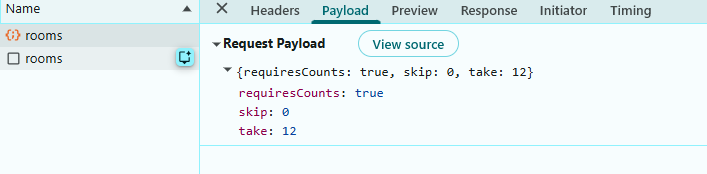
- The Grid sends page size
takeand skip countskipparameters to the server. - The
operation.PerformSkip()method skips the specified number of records. - The
operation.PerformTake()method retrieves only the required number of records for the current page. - The total count is calculated before paging to display the total number of records.
- Results are returned and displayed in the Grid with pagination controls.
When paging is performed in the Grid, a request is sent to the server with the following payload.
Step 7: Implement searching feature
Searching allows finding records by entering keywords in the search box.
Instructions:
- Ensure the toolbar includes the
Searchitem. - Inject the
Toolbarmodule in the Grid component.
import React from 'react';
import { GridComponent, ColumnsDirective, ColumnDirective, Inject, Toolbar } from '@syncfusion/ej2-react-grids';
import { DataManager } from '@syncfusion/ej2-data';
import { CustomAdaptor } from './CustomAdaptor';

const BASE_URL = 'https://localhost:7225/api/rooms';

const dataManager = new DataManager({
  url: `${BASE_URL}`,
  adaptor: new CustomAdaptor()
});

const toolbar: string[] = ['Search'];

const App: React.FC = () => {
  return (
    <GridComponent
        dataSource={dataManager}
        toolbar={toolbar}
    >
      <ColumnsDirective>
        <ColumnDirective field="Id" headerText="ID" isPrimaryKey isIdentity visible={false} />
        {/* Include additional columns here */}
      </ColumnsDirective>
      <Inject services={[Toolbar]} />
    </GridComponent>
  );
};

export default App;
Update the “List” method in the RoomsController.cs file to handle searching:
using Microsoft.AspNetCore.Mvc;
using Syncfusion.EJ2.Base;
using Grid_Dapper.Server.Data;
using System.Collections.Generic;
using System.Linq;

namespace Grid_Dapper.Server.Controllers
{
    [ApiController]
    [Route("api/[controller]")]
    public class RoomsController : ControllerBase
    {
        private readonly ReservationRepository _repo;
        private readonly DataOperations _dataOps = new DataOperations();

        public RoomsController(ReservationRepository repo)
        {
            _repo = repo;
        }

        // POST: api/rooms
        [HttpPost]
        public async Task<IActionResult> List([FromBody] DataManagerRequest dm)
        {
            IEnumerable<Reservation> data = await _repo.GetReservationsAsync();

            // Searching
            if (dm.Search != null && dm.Search.Count > 0)
                data = _dataOps.PerformSearching(data, dm.Search);

            // Other action code goes here

            int count = data.Count();

            return Ok(dm.RequiresCounts ? new { result = data, count } : data);
        }
    }
}
Searching details:
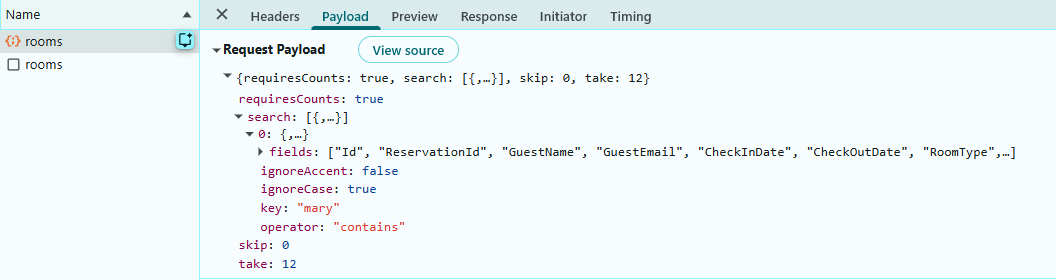
- When text is entered in the search box and Enter key is pressed, the Grid sends a search request to the server.
- The “List” method receives the search criteria in
searchparameter. - The
operation.PerformSearching()method filters the data based on the search term. - Results are returned and displayed in the Grid.
When searching is performed in the Grid, a request is sent to the server with the following payload.
Step 8: Implement filtering feature
Filtering allows restricting data based on column values using a menu interface.
Instructions:
- Filtering is enabled by setting the allowFiltering property to
true. - Inject the
Filtermodule in the Grid component.
import React from 'react';
import { GridComponent, ColumnsDirective, ColumnDirective, Inject, Filter, type FilterSettingsModel } from '@syncfusion/ej2-react-grids';
import { DataManager } from '@syncfusion/ej2-data';
import { CustomAdaptor } from './CustomAdaptor';

const BASE_URL = 'https://localhost:7225/api/rooms';

const dataManager = new DataManager({
  url: `${BASE_URL}`,
  adaptor: new CustomAdaptor()
});

const filterSettings: FilterSettingsModel = { type: 'Excel' };

const App: React.FC = () => {
  return (
    <GridComponent
        dataSource={dataManager}
        allowFiltering={true}
        filterSettings={filterSettings}
    >
      <ColumnsDirective>
        <ColumnDirective field="Id" headerText="ID" isPrimaryKey isIdentity visible={false} />
        {/* Include additional columns here */}
      </ColumnsDirective>
      <Inject services={[Filter]} />
    </GridComponent>
  );
};

export default App;
Update the “List” method in the RoomsController.cs file to handle filtering:
using Microsoft.AspNetCore.Mvc;
using Syncfusion.EJ2.Base;
using Grid_Dapper.Server.Data;
using System.Collections.Generic;
using System.Linq;

namespace Grid_Dapper.Server.Controllers
{
    [ApiController]
    [Route("api/[controller]")]
    public class RoomsController : ControllerBase
    {
        private readonly ReservationRepository _repo;
        private readonly DataOperations _dataOps = new DataOperations();

        public RoomsController(ReservationRepository repo)
        {
            _repo = repo;
        }

        // POST: api/rooms
        [HttpPost]
        public async Task<IActionResult> List([FromBody] DataManagerRequest dm)
        {
            IEnumerable<Reservation> data = await _repo.GetReservationsAsync();

            // Filtering
            if (dm.Where != null && dm.Where.Count > 0)
                data = _dataOps.PerformFiltering(data, dm.Where, dm.Where[0].Operator);

            // Other action code goes here

            int count = data.Count();

            return Ok(dm.RequiresCounts ? new { result = data, count } : data);
        }
    }
}
Filtering details:
- Open the filter menu from any of the column header.
- Select filtering criteria (equals, contains, greater than, less than, etc.).
- Click the “Filter” button to apply the filter.
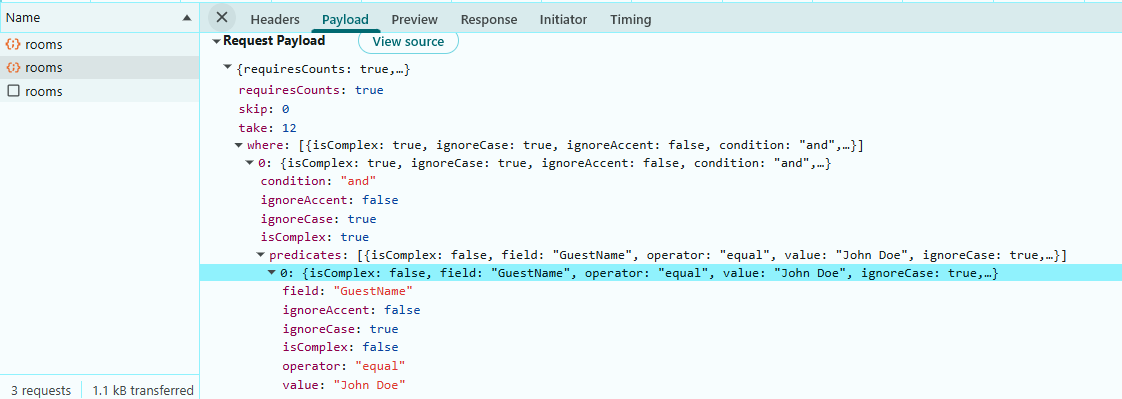
- The “List” method receives the filter criteria in
whereproperty. - Results are filtered accordingly and displayed in the Grid.
When filtering is performed in the Grid, a request is sent to the server with the following payload.
Step 9: Implement sorting feature
Sorting enables arranging records in ascending or descending order based on column values.
Instructions:
- Sorting can be enabled by setting the allowSorting property to
true. - Inject the
Sortmodule in the Grid component.
import React from 'react';
import { GridComponent, ColumnsDirective, ColumnDirective, Inject, Sort } from '@syncfusion/ej2-react-grids';
import { DataManager } from '@syncfusion/ej2-data';
import { CustomAdaptor } from './CustomAdaptor';

const BASE_URL = 'https://localhost:7225/api/rooms';

const dataManager = new DataManager({
  url: `${BASE_URL}`,
  adaptor: new CustomAdaptor()
});

const App: React.FC = () => {
  return (
    <GridComponent
        dataSource={dataManager}
        allowSorting={true}
    >
      <ColumnsDirective>
        <ColumnDirective field="Id" headerText="ID" isPrimaryKey isIdentity visible={false} />
        {/* Include additional columns here */}
      </ColumnsDirective>
      <Inject services={[Sort]} />
    </GridComponent>
  );
};

export default App;
Update the “List” method in the RoomsController.cs file to handle sorting:
using Microsoft.AspNetCore.Mvc;
using Syncfusion.EJ2.Base;
using Grid_Dapper.Server.Data;
using System.Collections.Generic;
using System.Linq;

namespace Grid_Dapper.Server.Controllers
{
    [ApiController]
    [Route("api/[controller]")]
    public class RoomsController : ControllerBase
    {
        private readonly ReservationRepository _repo;
        private readonly DataOperations _dataOps = new DataOperations();

        public RoomsController(ReservationRepository repo)
        {
            _repo = repo;
        }

        // POST: api/rooms
        [HttpPost]
        public async Task<IActionResult> List([FromBody] DataManagerRequest dm)
        {
            IEnumerable<Reservation> data = await _repo.GetReservationsAsync();

            // Sorting
            if (dm.Sorted != null && dm.Sorted.Count > 0)
                data = _dataOps.PerformSorting(data, dm.Sorted);

            // Other action code goes here

            int count = data.Count();

            return Ok(dm.RequiresCounts ? new { result = data, count } : data);
        }
    }
}
Sorting details:
- Click on the column header to sort in ascending order.
- Click again to sort in descending order.
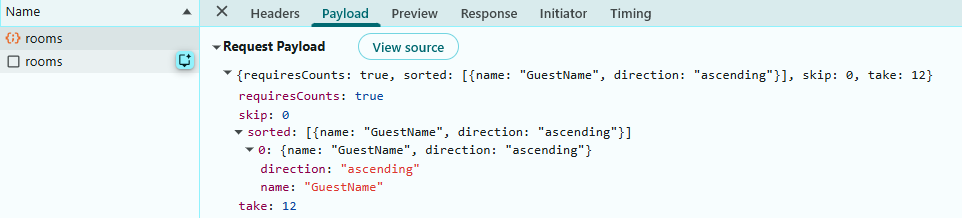
- The “List” method receives the sort criteria in
sorted. - Records are sorted accordingly and displayed in the Grid.
When sorting is performed in the Grid, a request is sent to the server with the following payload.
Step 10: Perform CRUD operations
CRUD operations allow adding new records, modifying existing records, and removing items that are no longer relevant. The DataManager posts a specific action for each operation so that the server can route to the appropriate handler.
Editing operations in the Grid are enabled through configuring the editSettings properties (allowEditing, allowAdding, and allowDeleting) to true. Inject the Edit and Toolbar modules in the Grid component.
import React from 'react';
import { GridComponent, ColumnsDirective, ColumnDirective, Inject, Toolbar, Edit, Sort, Filter, Page, type EditSettingsModel } from '@syncfusion/ej2-react-grids';
import { DataManager } from '@syncfusion/ej2-data';
import { CustomAdaptor } from './CustomAdaptor';

const BASE_URL = 'https://localhost:7225/api/rooms';

const dataManager = new DataManager({
  url: `${BASE_URL}`,
  insertUrl: `${BASE_URL}/insert`,
  updateUrl: `${BASE_URL}/update`,
  removeUrl: `${BASE_URL}/remove`,
  batchUrl: `${BASE_URL}/batch`,
  adaptor: new CustomAdaptor()
});

const editSettings: EditSettingsModel = { allowEditing: true, allowAdding: true, allowDeleting: true, mode: 'Normal' };

const toolbar: string[] = ['Add', 'Edit', 'Delete', 'Update', 'Cancel', 'Search'];

const App: React.FC = () => {
  return (
    <GridComponent
      dataSource={dataManager}
      editSettings={editSettings}
      toolbar={toolbar}
    >
      <ColumnsDirective>
        <ColumnDirective field="Id" headerText="ID" isPrimaryKey isIdentity visible={false} />
        {/* Include additional columns here */}
      </ColumnsDirective>
      <Inject services={[Toolbar, Edit, Sort, Filter, Page]} />
    </GridComponent>
  );
};

export default App;
Insert:
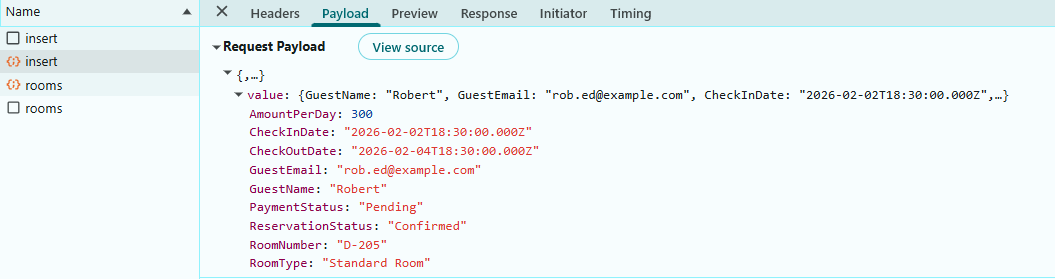
Record insertion allows new records to be added directly through the Grid component. The adaptor processes the insertion request, performs any required business‑logic validation, and saves the newly created record to the SQL database.
Implement the “insert” method in (src/CustomAdaptor.ts) to handle record insertion within the CustomAdaptor class:
  public override insert(dm: DataManager, data: DataResult) {
    return {
      url: `${dm.dataSource["insertUrl"]}`,
      type: "POST",
      contentType: "application/json; charset=utf-8",
      data: JSON.stringify({ value: data }),
    };
  }
In RoomsController.cs, implement the “Insert” method:
        // INSERT
        // POST api/rooms/insert
        [HttpPost("insert")]
        public async Task<IActionResult> Insert([FromBody] CRUDModel<Reservation> args)
        {
           if (args?.Value == null)
               return BadRequest("Invalid payload.");
           var created = await _repo.AddReservationAsync(args.Value);
           return Ok(created);
        }
What happens behind the scenes:
- The form data is collected and validated in the CustomAdaptor’s “insert” method.
- The “Insert” method in RoomsController.cs file is called.
- The new record is added to the “Rooms” table via the repository.
- The Grid automatically refreshes to display the new record.
When a new record is added in the Grid, a request is sent to the server with the following payload.
Update:
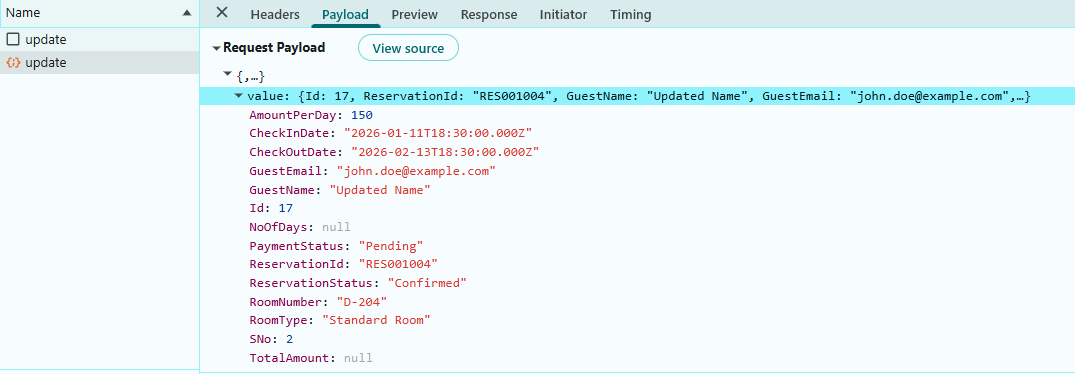
Record modification allows record details to be updated directly within the Grid. The adaptor processes the edited row, validates the updated values, and applies the changes to the SQL database while ensuring data integrity is preserved.
Implement the “update” method in (src/CustomAdaptor.ts) to handle record update within the CustomAdaptor class:
  public override update(dm: DataManager, _keyField: string, value: any) {
    return {
      url: `${dm.dataSource["updateUrl"]}`,
      type: "POST",
      contentType: "application/json; charset=utf-8",
      data: JSON.stringify({ value }),
    };
  }
In RoomsController.cs, implement the update method:
        // UPDATE
        // POST api/rooms/update
        [HttpPost("update")]
        public async Task<IActionResult> Update([FromBody] CRUDModel<Reservation> args)
        {
           if (args?.Value == null)
               return BadRequest("Invalid payload.");
           if (args.Value.Id <= 0)
               return BadRequest("Id is required for update.");
           var updated = await _repo.UpdateReservationAsync(args.Value);
           return Ok(updated);
        }
What happens behind the scenes:
- The modified data is collected and validated in the CustomAdaptor’s “update” method.
- The “Update” method in RoomsController.cs file is called.
- The existing record is located by “Id” and all properties are updated with the new values.
- The Grid refreshes to display the updated record.
When a record is updated in the Grid, a request is sent to the server with the following payload.
Delete:
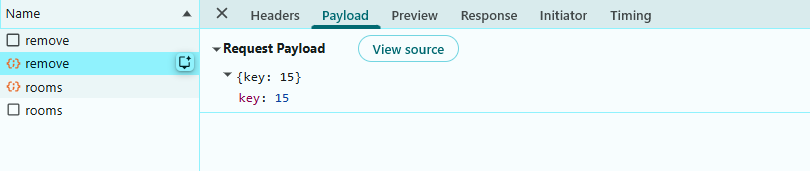
Record deletion allows record to be removed directly from the Grid. The adaptor captures the delete request, executes the corresponding SQL DELETE operation, and updates both the database and the grid to reflect the removal.
Implement the “remove” method in (src/CustomAdaptor.ts) to handle record deletion within the CustomAdaptor class:
  public override remove(dm: DataManager, keyField: string, value: any) {
    const keyValue =
      value && typeof value === "object" ? value[keyField] : value;
    return {
      url: `${dm.dataSource["removeUrl"]}`,
      type: "POST",
      contentType: "application/json; charset=utf-8",
      data: JSON.stringify({ key: keyValue }),
    };
  }
In RoomsController.cs, implement the delete method:
        // REMOVE
        // POST api/rooms/remove
        // UrlAdaptor sends { key: <id>, keyColumn: "Id", action: "remove" }
        [HttpPost("remove")]
        public async Task<IActionResult> Remove([FromBody] CRUDModel<Reservation> args)
        {
           if (args == null || args.Key == null)
               return BadRequest("Key is required.");
           if (!int.TryParse(args.Key.ToString(), out var id))
               return BadRequest("Invalid key format.");

           await _repo.RemoveReservationAsync(id);
           return Ok(new { Id = id });
        }
What happens behind the scenes:
- A record is selected and the
Deletebutton is clicked. - The CustomAdaptor’s “remove” method is called.
- The “Remove” method in RoomsController.cs file is called.
- The record is located in the database by its “Id”.
- The record is deleted from the “Rooms” table via the repository.
- The Grid refreshes to remove the deleted record from the UI.
When a record is deleted in the Grid, a request is sent to the server with the following payload.
Batch update:
Batch operations combine multiple insert, update, and delete actions into a single request, minimizing network overhead by applying all changes atomically to the SQL database.
Implement the batchRequest method in (src/CustomAdaptor.ts) to handle multiple record updates in a single request within the CustomAdaptor class:
  public override batchRequest(dm: DataManager, changes: BatchChanges) {
    return {
      url: `${dm.dataSource["batchUrl"]}`,
      type: "POST",
      contentType: "application/json; charset=utf-8",
      data: JSON.stringify({
        added: changes.addedRecords,
        changed: changes.changedRecords,
        deleted: changes.deletedRecords,
      }),
    };
  }
In RoomsController.cs, implement the batch method:
        // BATCH
        // POST api/rooms/batch
        [HttpPost("batch")]
        public async Task<IActionResult> Batch([FromBody] CRUDModel<Reservation> args)
        {
           if (args == null)
               return BadRequest("Invalid payload.");

           if (args.Changed != null)
           {
               foreach (var t in args.Changed)
                   await _repo.UpdateReservationAsync(t);
           }

           if (args.Added != null)
           {
               for (int i = 0; i < args.Added.Count; i++)
                   args.Added[i] = await _repo.AddReservationAsync(args.Added[i]);
           }

           if (args.Deleted != null)
           {
               foreach (var t in args.Deleted)
                   await _repo.RemoveReservationAsync(t.Id);
           }

           return Ok(new { status = "ok" });
        }
This method is triggered when the Grid is operating in Batch edit mode.
What happens behind the scenes:
- The Grid collects all added, edited, and deleted records in
Batchedit mode. - The combined batch request is passed to the CustomAdaptor’s
batchRequestmethod. - Each modified record, added and deleted records are processed using the
Batchmethod in RoomsController.cs file. - All repository operations persist changes to the SQL database.
- The Grid refreshes to display the updated, added, and removed records in a single response.
When a batch update is performed in the Grid, a request is sent to the server with the following payload.

Now the adaptor supports bulk modifications with atomic database synchronization. All CRUD operations are now fully implemented, enabling comprehensive data management capabilities within the React Grid.
Step 11: Complete code
Here is the complete and final (src/App.tsx) component with all features integrated:
// File: src/App.tsx
import React from 'react';
import {
  GridComponent,
  ColumnsDirective,
  ColumnDirective,
  Inject,
  Page,
  Sort,
  Filter,
  Edit,
  Toolbar,
  Group,
  type FilterSettingsModel,
  type PageSettingsModel
} from '@syncfusion/ej2-react-grids';
import { DataManager } from '@syncfusion/ej2-data';
import './app.css';
import { CustomAdaptor } from './CustomAdaptor';

const BASE_URL = 'https://localhost:7225/api/rooms';

const dataManager = new DataManager({
  url: `${BASE_URL}`,
  insertUrl: `${BASE_URL}/insert`,
  updateUrl: `${BASE_URL}/update`,
  removeUrl: `${BASE_URL}/remove`,
  batchUrl: `${BASE_URL}/batch`,
  adaptor: new CustomAdaptor()
});

const toolbar: string[] = ['Add', 'Edit', 'Delete', 'Update', 'Cancel', 'Search'];
const editSettings = { allowEditing: true, allowAdding: true, allowDeleting: true, mode: 'Normal' as const };
const filterSettings: FilterSettingsModel = { type: 'Excel' };

const guestNameValidation = { required: true, minLength: 3 };

const paymentStatusTemplate = (data: ReservationRow) => (
  <span>
    {data.PaymentStatus}
  </span>
);

const reservationStatusTemplate = (data: ReservationRow) => (
  <span>
    {data.ReservationStatus}
  </span>
);

const App: React.FC = () => {
  return (
    <div className="container-fluid p-4">
      <GridComponent
        id="grid"
        width="100%"
        height="500px"
        dataSource={dataManager}
        allowSorting
        allowFiltering
        allowGrouping
        allowPaging
        toolbar={toolbar}
        editSettings={editSettings}
        filterSettings={filterSettings}
      >
        <ColumnsDirective>
          <ColumnDirective
            field="Id"
            headerText="ID"
            isPrimaryKey
            isIdentity
            visible={false}
          />
          <ColumnDirective
            field="ReservationId"
            headerText="Reservation ID"
            width={170}
            allowEditing={false}
          />
          <ColumnDirective
            field="GuestName"
            headerText="Guest Name"
            width={160}
            validationRules={guestNameValidation}
          />
          <ColumnDirective
            field="GuestEmail"
            headerText="Email"
            width={200}
          />
          <ColumnDirective
            field="CheckInDate"
            headerText="Check-In"
            width={140}
            type="date"
            format="dd-MMM-yyyy"
            editType="datepickeredit"
          />
          <ColumnDirective
            field="CheckOutDate"
            headerText="Check-Out"
            width={140}
            type="date"
            format="dd-MMM-yyyy"
            editType="datepickeredit"
          />
          <ColumnDirective
            field="RoomType"
            headerText="Room Type"
            width={130}
            editType="dropdownedit"
          />
          <ColumnDirective
            field="RoomNumber"
            headerText="Room Number"
            width={150}
          />
          <ColumnDirective
            field="AmountPerDay"
            headerText="Amount Per Day"
            width={170}
            format="N2"
            textAlign="Right"
            editType="numericedit"
          />
          <ColumnDirective
            field="NoOfDays"
            headerText="Number of Days"
            width={170}
            textAlign="Right"
            allowEditing={false}
          />
          <ColumnDirective
            field="TotalAmount"
            headerText="Total Amount"
            width={160}
            format="N2"
            textAlign="Right"
            allowEditing={false}
          />
          <ColumnDirective
            field="PaymentStatus"
            headerText="Payment"
            width={110}
            editType="dropdownedit"
            template={paymentStatusTemplate}
          />
          <ColumnDirective
            field="ReservationStatus"
            headerText="Status"
            width={120}
            editType="dropdownedit"
            template={reservationStatusTemplate}
          />
        </ColumnsDirective>
        <Inject services={[Page, Filter, Sort, Group, Edit, Toolbar]} />
      </GridComponent>
    </div>
  );
};

export default App;

export interface ReservationRow {
  Id: number;
  ReservationId: string;
  GuestName: string;
  GuestEmail: string;
  CheckInDate?: string | Date | null;
  CheckOutDate?: string | Date | null;
  RoomType: string;
  RoomNumber: string;
  AmountPerDay: number;
  NoOfDays: number;
  TotalAmount: number;
  PaymentStatus: string;
  ReservationStatus: string;
}
- Set isPrimaryKey to
truefor a column that contains unique values.- The editType property can be used to specify the desired editor for each column.
- The type property of the Grid columns specifies the data type of a grid column.
Here is the complete Controller RoomsController.cs file:
using Microsoft.AspNetCore.Mvc;
using Syncfusion.EJ2.Base;
using Grid_Dapper.Server.Data;
using System.Collections.Generic;
using System.Linq;

namespace Grid_Dapper.Server.Controllers
{
    [ApiController]
    [Route("api/[controller]")]
    public class RoomsController : ControllerBase
    {
        private readonly ReservationRepository _repo;
        private readonly DataOperations _dataOps = new DataOperations();

        public RoomsController(ReservationRepository repo)
        {
            _repo = repo;
        }

        // POST: api/rooms
        [HttpPost]
        public async Task<IActionResult> List([FromBody] DataManagerRequest dm)
        {
            IEnumerable<Reservation> data = await _repo.GetReservationsAsync();

            // Searching
            if (dm.Search != null && dm.Search.Count > 0)
            {
                data = _dataOps.PerformSearching(data, dm.Search);
            }

            // Filtering
            if (dm.Where != null && dm.Where.Count > 0)
            {
                data = _dataOps.PerformFiltering(data, dm.Where, dm.Where[0].Operator);
            }

            // Sorting
            if (dm.Sorted != null && dm.Sorted.Count > 0)
            {
                data = _dataOps.PerformSorting(data, dm.Sorted);
            }

            // Count BEFORE paging
            int count = data.Count();

            // Paging
            if (dm.Skip != 0)
                data = _dataOps.PerformSkip(data, dm.Skip);
            if (dm.Take != 0)
                data = _dataOps.PerformTake(data, dm.Take);

            // Final shape required by UrlAdaptor
            return Ok(dm.RequiresCounts ? new { result = data, count } : data);
        }

        [HttpGet("ping")]
        public IActionResult Ping() => Ok(new { ok = true, time = DateTime.UtcNow });

        // INSERT
        // POST api/rooms/insert
        [HttpPost("insert")]
        public async Task<IActionResult> Insert([FromBody] CRUDModel<Reservation> args)
        {
           if (args?.Value == null)
               return BadRequest("Invalid payload.");
           var created = await _repo.AddReservationAsync(args.Value);
           return Ok(created);
        }

        // UPDATE
        // POST api/rooms/update
        [HttpPost("update")]
        public async Task<IActionResult> Update([FromBody] CRUDModel<Reservation> args)
        {
           if (args?.Value == null)
               return BadRequest("Invalid payload.");
           if (args.Value.Id <= 0)
               return BadRequest("Id is required for update.");
           var updated = await _repo.UpdateReservationAsync(args.Value);
           return Ok(updated);
        }

        // REMOVE
        // POST api/rooms/remove
        // UrlAdaptor sends { key: <id>, keyColumn: "Id", action: "remove" }
        [HttpPost("remove")]
        public async Task<IActionResult> Remove([FromBody] CRUDModel<Reservation> args)
        {
           if (args == null || args.Key == null)
               return BadRequest("Key is required.");
           if (!int.TryParse(args.Key.ToString(), out var id))
               return BadRequest("Invalid key format.");

           await _repo.RemoveReservationAsync(id);
           return Ok(new { Id = id });
        }

        // BATCH
        // POST api/rooms/batch
        [HttpPost("batch")]
        public async Task<IActionResult> Batch([FromBody] CRUDModel<Reservation> args)
        {
           if (args == null)
               return BadRequest("Invalid payload.");

           if (args.Changed != null)
           {
               foreach (var t in args.Changed)
                   await _repo.UpdateReservationAsync(t);
           }

           if (args.Added != null)
           {
               for (int i = 0; i < args.Added.Count; i++)
                   args.Added[i] = await _repo.AddReservationAsync(args.Added[i]);
           }

           if (args.Deleted != null)
           {
               foreach (var t in args.Deleted)
                   await _repo.RemoveReservationAsync(t.Id);
           }

           return Ok(new { status = "ok" });
        }
    }
}
Running the application
Follow the steps below to set up and run both the backend server and the React frontend client.
Running the ASP.NET Core backend server
Step 1: Build the backend:
- Open the terminal or Package Manager Console.
- Navigate to the Grid_Dapper.Server project directory.
- Run the following command:
dotnet buildStep 2: Run the backend server:
Execute the following command:
dotnet runStep 3: Verify backend is running:
- The backend server should start and listen on https://localhost:7225 (or the port shown in the terminal).
- Test the API endpoint: https://localhost:7225/api/rooms
Running the React frontend client
- Open a new terminal.
- Navigate to the grid_dapper.client directory.
- Run the following command:
npm run devStep 3: Access the application:
- Open a web browser.
- Navigate to http://localhost:5173 (Vite default) or the port shown in the terminal.
- The application will automatically connect to the backend API at https://localhost:7225/api/rooms.
- The hotel reservation management application is now running and ready to use.
Available features:
- View Data: All reservations from the SQL database are displayed in the Grid.
- Search: Use the search box to find reservations by any field.
- Filter: Click on column headers to apply filters.
- Sort: Click on column headers to sort data in ascending or descending order.
- Pagination: Navigate through records using page numbers.
-
Add: Click the
Addbutton to create a new reservation. -
Edit: Click the
Editbutton to modify existing reservations. -
Delete: Click the
Deletebutton to remove reservations.
Complete sample repository
A complete, working sample implementation is available in the GitHub repository.