Getting Started with React Gantt Chart
This guide walks you through installing and rendering your first React Gantt Chart component. You’ll learn how to bind task data, map fields, and display a basic project schedule in just a few minutes.
Prerequisites
- Node.js 24+ (LTS recommended).
- Syncfusion CLI.
Install the Syncfusion CLI
Install the Syncfusion CLI globally using the following command:
npm install -g @syncfusion/syncfusion-cliSet up the Vite project using Syncfusion CLI
You can create a React Vite application using the Syncfusion CLI. The CLI provides two ways to create a project:
Non-interactive mode
Non-interactive mode allows you to create a project directly using a single command with the required command-line arguments.
sf new my-gantt-app --framework react --type ts --template gantt --theme tailwind3In this mode, the project configuration is passed directly in the command. The above command creates a React Vite application configured with the Syncfusion® Gantt Chart component.
Interactive mode
Interactive mode guides you through the project creation process with step-by-step prompts.
sfWhen you run the sf command, the CLI prompts you to select the required project configuration. To create a React Vite application with the Syncfusion® Gantt Chart component, select the following options:
√ Project name? ... my-gantt-app
√ Choose Framework: » React
√ Choose Build Tool: » Vite
√ Choose Language: » TypeScript
√ Choose Template: » Gantt
√ Choose Theme: » Tailwind3
√ Choose Style Format: » CSS
√ Would you like to integrate the Syncfusion MCP Server (AI Assistant) into this project? ... no
√ Would you like to install Syncfusion Component Skills for AI-powered development? ... no
√ Install dependencies and start app now? ... no
The above selections generate a React Vite application configured with the Syncfusion® Gantt Chart component. You can choose different values for language, theme, style format, MCP setup, and skills installation based on your project requirements.
The Syncfusion® CLI creates the project with a predefined template. After the project is generated, you can customize or replace the component code based on your application requirements.
Run the project
Once the project is created, navigate to the project directory and run the following commands in your terminal.
cd my-gantt-app
npm install
npm run dev
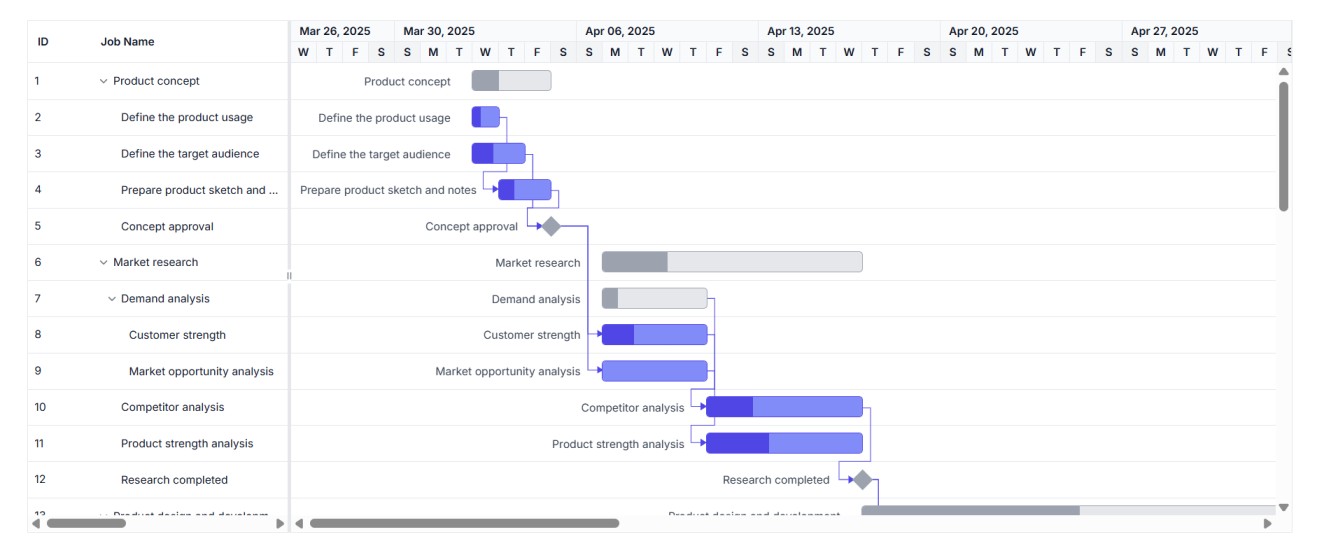
The output will appear as follows:
Prerequisites
Before you begin, ensure you have:
- Node.js (v14.0 or later)
- npm or yarn package manager
- Basic knowledge of React (v18 or later recommended)
Installation
Create a new React app using Vite with TypeScript:
npm create vite@latest my-gantt-app -- --template react-ts
cd my-gantt-app
Use
--template reactfor JavaScript instead of TypeScript.
Install the Gantt Chart package:
npm install @syncfusion/ej2-react-gantt
To install a specific version (for matching an internal version pin), use
npm install @syncfusion/ej2-react-gantt@<version>. Theej2-baseand other dependent@syncfusion/ej2-*packages are installed transitively.
If you created the app with the JavaScript Vite template instead of TypeScript, use src/App.jsx and keep the same component structure with JSX syntax.
Add theme styles
Themes for Syncfusion® Gantt Chart component can be applied using CSS files provided through npm theme packages. For available themes, refer to the Themes documentation.
Install the Tailwind 3 theme package using the following command:
npm install @syncfusion/ej2-tailwind3-theme --saveThen add the following CSS reference to the src/App.css file:
@import "../node_modules/@syncfusion/ej2-tailwind3-theme/styles/gantt/index.css";Create sample data
Define a simple task list with hierarchical relationships. Each task must have a StartDate and either a Duration or EndDate to render properly. If both are provided, EndDate takes precedence. The Duration value is in working days; EndDate is an absolute calendar date.
const taskData = [
  { TaskID: 1, TaskName: 'Project initiation', StartDate: new Date('2024-04-01'), EndDate: new Date('2024-04-15') },
  { TaskID: 2, TaskName: 'Identify site location', StartDate: new Date('2024-04-01'), Duration: 4, Progress: 70, ParentID: 1 },
  { TaskID: 3, TaskName: 'Perform site survey', StartDate: new Date('2024-04-01'), Duration: 4, Progress: 50, ParentID: 1 },
  { TaskID: 4, TaskName: 'Soil testing', StartDate: new Date('2024-04-01'), Duration: 3, Progress: 40, ParentID: 1 },
  { TaskID: 5, TaskName: 'Project estimation', StartDate: new Date('2024-04-15'), EndDate: new Date('2024-04-25') },
  { TaskID: 6, TaskName: 'Develop floor plan', StartDate: new Date('2024-04-15'), Duration: 5, Progress: 30, ParentID: 5 },
  { TaskID: 7, TaskName: 'Estimate project cost', StartDate: new Date('2024-04-15'), Duration: 5, Progress: 20, ParentID: 5 }
];
Configure task fields
Map your data fields to Gantt Chart properties using taskFields:
const taskFields = {
  id: 'TaskID',
  name: 'TaskName',
  startDate: 'StartDate',
  endDate: 'EndDate',
  duration: 'Duration',
  progress: 'Progress',
  parentID: 'ParentID'
};
Field mapping reference
| Property | Description | Required |
|---|---|---|
id |
Unique task identifier | Yes |
name |
Task display name | Yes |
startDate |
Task start date | Yes |
duration |
Task duration in working days (numeric, optional decimal) | No (use endDate instead) |
endDate |
Task end date | No (use duration instead) |
progress |
Task completion percentage (0–100) | No |
parentID |
Parent task ID for hierarchy | No |
dependency |
Predecessor relationships (e.g., 2FS+1d) |
No |
hasChildMapping |
Indicates whether a row has child rows (load-on-demand) | No |
resourceInfo |
Field name that holds resource data | No |
Render the Gantt Chart component
Put it all together in src/App.tsx. The taskData and taskFields variables defined earlier are reused here.
import { GanttComponent } from '@syncfusion/ej2-react-gantt';
import './App.css';

const taskData = [
  { TaskID: 1, TaskName: 'Project initiation', StartDate: new Date('2024-04-01'), EndDate: new Date('2024-04-15') },
  { TaskID: 2, TaskName: 'Identify site location', StartDate: new Date('2024-04-01'), Duration: 4, Progress: 70, ParentID: 1 },
  { TaskID: 3, TaskName: 'Perform site survey', StartDate: new Date('2024-04-01'), Duration: 4, Progress: 50, ParentID: 1 },
  { TaskID: 4, TaskName: 'Soil testing', StartDate: new Date('2024-04-01'), Duration: 3, Progress: 40, ParentID: 1 },
  { TaskID: 5, TaskName: 'Project estimation', StartDate: new Date('2024-04-15'), EndDate: new Date('2024-04-25') },
  { TaskID: 6, TaskName: 'Develop floor plan', StartDate: new Date('2024-04-15'), Duration: 5, Progress: 30, ParentID: 5 },
  { TaskID: 7, TaskName: 'Estimate project cost', StartDate: new Date('2024-04-15'), Duration: 5, Progress: 20, ParentID: 5 }
];

const taskFields = {
  id: 'TaskID',
  name: 'TaskName',
  startDate: 'StartDate',
  endDate: 'EndDate',
  duration: 'Duration',
  progress: 'Progress',
  parentID: 'ParentID'
};

export default function App() {
  return (
    <GanttComponent
      dataSource={taskData}
      taskFields={taskFields}
      height="450px"
    />
  );
}
Run the application
npm run dev
Access the running application through your configured development URL (Vite default: http://localhost:5173).
Output
You will see a Gantt Chart with:
- Task hierarchy with parent-child relationships
- Timeline view showing task bars
- Progress indicators on each task
- Automatically calculated dates based on duration
The chart displays two parent tasks (“Project initiation” and “Project estimation”) with their subtasks shown in a tree structure. Task bars are rendered on the timeline, sized according to their duration and start dates.
You can preview the following sample by clicking the Preview Sample button.
import * as React from 'react';
import * as ReactDOM from 'react-dom';
import { GanttComponent } from '@syncfusion/ej2-react-gantt';

const data = [
    { TaskID: 1, TaskName: 'Project initiation', StartDate: new Date('2024-04-01'), EndDate: new Date('2024-04-15') },
    { TaskID: 2, TaskName: 'Identify site location', StartDate: new Date('2024-04-01'), Duration: 4, Progress: 70, ParentID: 1 },
    { TaskID: 3, TaskName: 'Perform site survey', StartDate: new Date('2024-04-01'), Duration: 4, Progress: 50, ParentID: 1 },
    { TaskID: 4, TaskName: 'Soil testing', StartDate: new Date('2024-04-01'), Duration: 3, Progress: 40, ParentID: 1 },
    { TaskID: 5, TaskName: 'Project estimation', StartDate: new Date('2024-04-08'), EndDate: new Date('2024-04-18') },
    { TaskID: 6, TaskName: 'Develop floor plan', StartDate: new Date('2024-04-08'), Duration: 5, Progress: 30, ParentID: 5 },
    { TaskID: 7, TaskName: 'Estimate project cost', StartDate: new Date('2024-04-08'), Duration: 5, Progress: 20, ParentID: 5 }
];

const taskFields = {
    id: 'TaskID',
    name: 'TaskName',
    startDate: 'StartDate',
    duration: 'Duration',
    progress: 'Progress',
    parentID: 'ParentID'
};

export default function App() {
    return <GanttComponent dataSource={data} taskFields={taskFields} height="400px" />;
}

ReactDOM.render(<App />, document.getElementById('root'));
import * as React from 'react';
import * as ReactDOM from 'react-dom';
import { GanttComponent } from '@syncfusion/ej2-react-gantt';
const data: object[] = [
{ TaskID: 1, TaskName: 'Project initiation', StartDate: new Date('2024-04-01'), EndDate: new Date('2024-04-15') },
{ TaskID: 2, TaskName: 'Identify site location', StartDate: new Date('2024-04-01'), Duration: 4, Progress: 70, ParentID: 1 },
{ TaskID: 3, TaskName: 'Perform site survey', StartDate: new Date('2024-04-01'), Duration: 4, Progress: 50, ParentID: 1 },
{ TaskID: 4, TaskName: 'Soil testing', StartDate: new Date('2024-04-01'), Duration: 3, Progress: 40, ParentID: 1 },
{ TaskID: 5, TaskName: 'Project estimation', StartDate: new Date('2024-04-08'), EndDate: new Date('2024-04-18') },
{ TaskID: 6, TaskName: 'Develop floor plan', StartDate: new Date('2024-04-08'), Duration: 5, Progress: 30, ParentID: 5 },
{ TaskID: 7, TaskName: 'Estimate project cost', StartDate: new Date('2024-04-08'), Duration: 5, Progress: 20, ParentID: 5 }
];
const taskFields: any = {
id: 'TaskID',
name: 'TaskName',
startDate: 'StartDate',
duration: 'Duration',
progress: 'Progress',
parentID: 'ParentID'
};
export default function App() {
return <GanttComponent dataSource={data} taskFields={taskFields} height="400px" />;
};
ReactDOM.render(<App />, document.getElementById('root'));Troubleshooting
-
License warning in console: Register a valid Syncfusion license key using
registerLicensefrom@syncfusion/ej2-base. You can obtain a key from your Syncfusion account. -
Styles not applied: Verify the CSS
@importpaths resolve fromsrc/. With Vite, prefer importing CSS insrc/main.tsxif@importinside CSS fails. -
Peer dependency errors: Ensure React 18+ is installed (
npm install react@18 react-dom@18). -
TypeScript errors on task data: Define an interface for your task records, e.g.
interface ITask { TaskID: number; TaskName: string; StartDate: Date; Duration?: number; EndDate?: Date; Progress?: number; ParentID?: number; }.
Next Steps
- Key Elements - Learn about UI components and interactions
- Feature Modules - Enable advanced features with module injection
- Overview - Explore all available features
Looking for the full React Gantt Chart component overview, features, pricing, and documentation? Visit the React Gantt Chart page.