How can I help you?
Getting Started with React AutoComplete component
10 Feb 202613 minutes to read
This section explains the steps required to create a simple React AutoComplete component and demonstrate its basic usage in a React environment.
Ready to streamline your Syncfusion® React development? Discover the full potential of Syncfusion® React components with Syncfusion® AI Coding Assistant. Effortlessly integrate, configure, and enhance your projects with intelligent, context-aware code suggestions, streamlined setups, and real-time insights—all seamlessly integrated into your preferred AI-powered IDEs like VS Code, Cursor, Syncfusion® CodeStudio and more. Explore Syncfusion® AI Coding Assistant.
To get started quickly with React AutoComplete, you can watch this video:
Setup for local development
Easily set up a React application using create-vite-app, which provides a faster development environment, smaller bundle sizes, and optimized builds compared to traditional tools like create-react-app. For detailed steps, refer to the Vite installation instructions. Vite sets up your environment using JavaScript and optimizes your application for production.
Note: To create a React application using
create-react-app, refer to this documentation for more details.
To create a new React application, run the following command.
npm create vite@latest my-appThis command will prompt you for a few settings for the new project, such as selecting a framework and a variant.
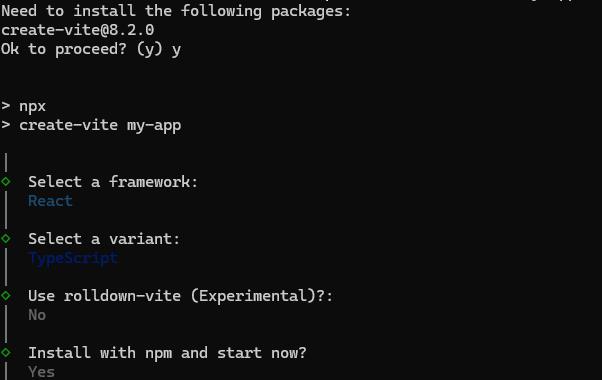
To set up a React application in TypeScript environment, run the following command.
npm create vite@latest my-app -- --template react-ts
cd my-app
npm run dev
To set up a React application in JavaScript environment, run the following command.
npm create vite@latest my-app -- --template react
cd my-app
npm run dev
Adding Syncfusion® AutoComplete packages
All the available Essential® JS 2 packages are published in the npmjs.com public registry.
To install the AutoComplete component, use the following command
npm install @syncfusion/ej2-react-dropdowns --saveThe –save will instruct NPM to include the AutoComplete package inside of the dependencies section of the package.json.
Adding CSS reference
The following CSS files are available in the ../node_modules/@syncfusion package folder. Add these as references in src/App.css.
@import "../node_modules/@syncfusion/ej2-base/styles/tailwind3.css";
@import "../node_modules/@syncfusion/ej2-react-inputs/styles/tailwind3.css";
@import "../node_modules/@syncfusion/ej2-react-dropdowns/styles/tailwind3.css";
To refer App.css in the application then import it in the src/App.tsx file.
Adding AutoComplete component
The React AutoComplete component can be added to the application by following these steps. To get started, add the AutoComplete component to the src/App.tsx file using the following code.
The following autocomplete code should be placed in the src/App.tsx file.
[Class-component]
import { AutoCompleteComponent } from '@syncfusion/ej2-react-dropdowns';
import * as React from 'react';
import './App.css';

export default class App extends React.Component<{}, {}> {
  public render() {
    return (
       // specifies the tag for render the AutoComplete component
      <AutoCompleteComponent id='atcelement'></AutoCompleteComponent>
    );
  }
}
[Functional-component]
import { AutoCompleteComponent } from '@syncfusion/ej2-react-dropdowns';
import * as React from 'react';
import './App.css';

export default function App() {
    return (
       // specifies the tag for render the AutoComplete component
      <AutoCompleteComponent id='atcelement'></AutoCompleteComponent>
    );
}
Binding data source
After initialization, populate the data using dataSource property. Here, an array of string values is passed to the AutoComplete component.
[Class-component]
import { AutoCompleteComponent } from '@syncfusion/ej2-react-dropdowns';
import * as React from 'react';
import './App.css';

export default class App extends React.Component<{}, {}> {
  // define the array of data
  private sportsData: string[] = ['Badminton', 'Basketball', 'Cricket', 'Football', 'Golf', 'Gymnastics', 'Hockey', 'Rugby', 'Snooker', 'Tennis'];
  public render() {
    return (
        // specifies the tag for render the AutoComplete component
      <AutoCompleteComponent id="atcelement" dataSource={this.sportsData} />
    );
  }
}
[Functional-component]
import { AutoCompleteComponent } from '@syncfusion/ej2-react-dropdowns';
import * as React from 'react';
import './App.css';

export default function App() {
  // define the array of data
  const sportsData: string[] = ['Badminton', 'Basketball', 'Cricket', 'Football', 'Golf', 'Gymnastics', 'Hockey', 'Rugby', 'Snooker', 'Tennis'];
  return (
      // specifies the tag for render the AutoComplete component
      <AutoCompleteComponent id="atcelement" dataSource={sportsData} />
    );
}
Run the application
Run the npm run dev command in the terminal to start the development server. This command compiles your code and serves the application locally, opening it in the browser.
npm run devThe output appears as follows.
[Class-component]
import { AutoCompleteComponent } from '@syncfusion/ej2-react-dropdowns';
import * as React from 'react';
import * as ReactDOM from 'react-dom';
export default class App extends React.Component {
    // define the array of data
    sportsData = ['Badminton', 'Basketball', 'Cricket', 'Football', 'Golf', 'Gymnastics', 'Hockey', 'Rugby', 'Snooker', 'Tennis'];
    render() {
        return (
        // specifies the tag for render the AutoComplete component
        <AutoCompleteComponent id="atcelement" dataSource={this.sportsData} placeholder="Find a game"/>);
    }
}
ReactDOM.render(<App />, document.getElementById('sample'));
import { AutoCompleteComponent } from '@syncfusion/ej2-react-dropdowns';
import * as React from 'react';
import * as ReactDOM from 'react-dom';
export default class App extends React.Component<{}, {}> {
// define the array of data
private sportsData: string[] = ['Badminton', 'Basketball', 'Cricket', 'Football', 'Golf', 'Gymnastics', 'Hockey', 'Rugby', 'Snooker', 'Tennis'];
public render() {
return (
// specifies the tag for render the AutoComplete component
<AutoCompleteComponent id="atcelement" dataSource={this.sportsData} placeholder="Find a game" />
);
}
}
ReactDOM.render(<App />, document.getElementById('sample'));[Functional-component]
import { AutoCompleteComponent } from '@syncfusion/ej2-react-dropdowns';
import * as React from 'react';
import * as ReactDOM from 'react-dom';
function App() {
    // define the array of data
    const sportsData = ['Badminton', 'Basketball', 'Cricket', 'Football', 'Golf', 'Gymnastics', 'Hockey', 'Rugby', 'Snooker', 'Tennis'];
    return (
    // specifies the tag for render the AutoComplete component
    <AutoCompleteComponent id="atcelement" dataSource={sportsData} placeholder="Find a game"/>);
}
ReactDOM.render(<App />, document.getElementById('sample'));
import { AutoCompleteComponent } from '@syncfusion/ej2-react-dropdowns';
import * as React from 'react';
import * as ReactDOM from 'react-dom';
function App() {
// define the array of data
const sportsData: string[] = ['Badminton', 'Basketball', 'Cricket', 'Football', 'Golf', 'Gymnastics', 'Hockey', 'Rugby', 'Snooker', 'Tennis'];
return (
// specifies the tag for render the AutoComplete component
<AutoCompleteComponent id="atcelement" dataSource={sportsData} placeholder="Find a game" />
);
}
ReactDOM.render(<App />, document.getElementById('sample'));Configure the Popup List
By default, the width of the popup list automatically adjusts according to the AutoComplete input element’s width and the height of the popup list has ‘300px’.
You can also customize the suggestion list height and width using popupHeight and popupWidth property respectively.
In the following sample, popup list’s width and height are configured.
[Class-component]
import { AutoCompleteComponent } from '@syncfusion/ej2-react-dropdowns';
import * as React from 'react';
import * as ReactDOM from 'react-dom';
export default class App extends React.Component {
    // define the array of data
    sportsData = ['Badminton', 'Basketball', 'Cricket', 'Football', 'Golf', 'Gymnastics', 'Hockey', 'Rugby', 'Snooker', 'Tennis'];
    render() {
        return (
        // specifies the tag for render the AutoComplete component
        <AutoCompleteComponent id="atcelement" dataSource={this.sportsData} popupHeight="250px" popupWidth="250px" placeholder="Find a game"/>);
    }
}
ReactDOM.render(<App />, document.getElementById('sample'));
import { AutoCompleteComponent } from '@syncfusion/ej2-react-dropdowns';
import * as React from 'react';
import * as ReactDOM from 'react-dom';
export default class App extends React.Component<{}, {}> {
// define the array of data
private sportsData: string[] = ['Badminton', 'Basketball', 'Cricket', 'Football', 'Golf', 'Gymnastics', 'Hockey', 'Rugby','Snooker', 'Tennis'];
public render() {
return (
// specifies the tag for render the AutoComplete component
<AutoCompleteComponent id="atcelement" dataSource={this.sportsData} popupHeight="250px" popupWidth="250px" placeholder="Find a game" />
);
}
}
ReactDOM.render(<App />, document.getElementById('sample'));[Functional-component]
import { AutoCompleteComponent } from '@syncfusion/ej2-react-dropdowns';
import * as React from 'react';
import * as ReactDOM from 'react-dom';
function App() {
    // define the array of data
    const sportsData = ['Badminton', 'Basketball', 'Cricket', 'Football', 'Golf', 'Gymnastics', 'Hockey', 'Rugby', 'Snooker', 'Tennis'];
    return (
    // specifies the tag for render the AutoComplete component
    <AutoCompleteComponent id="atcelement" dataSource={sportsData} popupHeight="250px" popupWidth="250px" placeholder="Find a game"/>);
}
ReactDOM.render(<App />, document.getElementById('sample'));
import { AutoCompleteComponent } from '@syncfusion/ej2-react-dropdowns';
import * as React from 'react';
import * as ReactDOM from 'react-dom';
function App() {
// define the array of data
const sportsData: string[] = ['Badminton', 'Basketball', 'Cricket', 'Football', 'Golf', 'Gymnastics', 'Hockey', 'Rugby','Snooker', 'Tennis'];
return (
// specifies the tag for render the AutoComplete component
<AutoCompleteComponent id="atcelement" dataSource={sportsData} popupHeight="250px" popupWidth="250px" placeholder="Find a game" />
);
}
ReactDOM.render(<App />, document.getElementById('sample'));Refer to the React AutoComplete feature tour page for its groundbreaking feature representations. You can also explore our React AutoComplete component example that shows how to render the AutoComplete in React.