Getting Started with Angular 3D Circular Chart
11 Aug 20268 minutes to read
This section explains the steps required to create a simple Angular 3D Circular Chart and demonstrates the basic usage of the Angular 3D Circular Chart component.
This guide supports Angular 21 and other recent Angular versions. For detailed compatibility with other Angular versions, please refer to the Angular version support matrix. Starting from Angular 19, standalone components are the default, and this guide reflects that architecture.
Ready to streamline your Syncfusion® Angular development? Discover the full potential of Syncfusion® Angular components with Syncfusion® AI Coding Assistant. Effortlessly integrate, configure, and enhance your projects with intelligent, context-aware code suggestions, streamlined setups, and real-time insights—all seamlessly integrated into your preferred AI-powered IDEs like VS Code, Cursor, Syncfusion® CodeStudio and more. Explore Syncfusion® AI Coding Assistant
Prerequisites
Before getting started, ensure that your environment meets the system requirements for Syncfusion® Angular UI components, which covers supported Node.js, Angular, and @syncfusion/ej2-angular-charts versions.
Setup the Angular application
A straightforward approach to begin with Angular is to create a new application using the Angular CLI. Install Angular CLI globally with the following command:
npm install -g @angular/cliVerify the installation:
ng versionAngular 21 Standalone Architecture: Standalone components are the default in Angular 21. This guide uses the modern standalone architecture. If you need more information about the standalone architecture, refer to the Standalone Guide.
Installing a specific version
To install a particular version of Angular CLI, use:
npm install -g @angular/[email protected]Create an Angular application
With Angular CLI installed, execute this command to generate a new application:
ng new syncfusion-angular-app- This command will prompt you to configure settings like enabling Angular routing and choosing a stylesheet format.
? Which stylesheet format would you like to use? (Use arrow keys)
> CSS             [ https://developer.mozilla.org/docs/Web/CSS                     ]
  Sass (SCSS)     [ https://sass-lang.com/documentation/syntax#scss                ]
  Sass (Indented) [ https://sass-lang.com/documentation/syntax#the-indented-syntax ]
Less [ http://lesscss.org ]- By default, a CSS-based application is created. Use SCSS if required:
ng new syncfusion-angular-app- During project setup, when prompted for the Server-side rendering (SSR) option, choose the appropriate configuration.

- Select the required AI tool or ‘none’ if you do not need any AI tool.
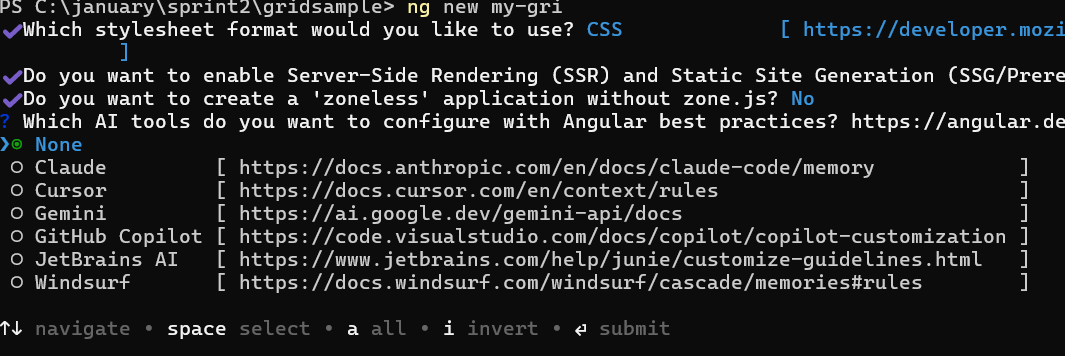
- Navigate to your newly created application directory:
cd syncfusion-angular-appIn Angular 19 and below, the CLI generates files like
app.component.ts,app.component.html,app.component.css, etc. In Angular 20+, the CLI generates a simpler structure withsrc/app/app.ts,app.html, andapp.css(no.component.suffixes).
Adding the Syncfusion® Angular 3D Circular Chart package
To install the Syncfusion® Angular 3D Circular Chart package, use the following command:
ng add @syncfusion/ej2-angular-chartsThe ng add command installs the package, registers it in package.json, and configures the required entries in your workspace automatically.
If ng add is unavailable in your setup, install the package manually with:
npm install @syncfusion/ej2-angular-chartsAdd Syncfusion® 3D Circular Chart component
Replace the contents of src/app/app.ts (Angular 20+) or src/app/app.component.ts (Angular 19 and below) with the following to render the 3D Circular Chart component:
import { Component } from '@angular/core';
import { CircularChart3DAllModule } from '@syncfusion/ej2-angular-charts';

@Component({
    imports: [CircularChart3DAllModule],
    standalone: true,
    selector: 'app-root',
    // specifies the template string for the 3D Circular Chart component
    template: `<ejs-circularchart3d id='chart3d-container'></ejs-circularchart3d>`,
})
export class AppComponent { }
Module Injection
3D Circular Chart components are segregated into individual feature-wise modules. To use a particular feature, you need to inject its feature service in src/app/app.ts (Angular 20+) or src/app/app.component.ts (Angular 19 and below). This example will use the tooltip feature of the chart.
-
CircularChartTooltip3DService- Inject this provider to use the tooltip feature.
Replace the contents of src/app/app.ts (or src/app/app.component.ts on Angular 19 and below) with the following:
import { Component } from '@angular/core';
import { CircularChart3DModule, CircularChartTooltip3DService } from '@syncfusion/ej2-angular-charts';

@Component({
    imports: [CircularChart3DModule],
    standalone: true,
    selector: 'app-root',
    providers: [CircularChartTooltip3DService],
    template: `<ejs-circularchart3d id='chart3d-container' [tooltip]='tooltip'></ejs-circularchart3d>`,
})
export class AppComponent {
    public tooltip: Object = { enable: true };
}
Bind data to the Circular 3D Chart
This section explains how to plot JSON data to the 3D Circular Chart. Replace the contents of src/app/app.ts (Angular 20+) or src/app/app.component.ts (Angular 19 and below) with the following:
import {
  CircularChart3DModule,
  CircularChartTooltip3DService,
  CircularChartLegend3DService,
  CircularChartDataLabel3DService,
  PieSeries3DService,
} from '@syncfusion/ej2-angular-charts';
import { Component } from '@angular/core';

@Component({
  imports: [CircularChart3DModule],
  standalone: true,
  selector: 'app-root',
  providers: [
    CircularChartTooltip3DService,
    CircularChartLegend3DService,
    CircularChartDataLabel3DService,
    PieSeries3DService,
  ],
  template: `<ejs-circularchart3d id="chart3d-container" style='display:block;' align='center' tilt='-45' [title]='title' [tooltip]='tooltip' [legendSettings]='legendSettings'>
    <e-circularchart3d-series-collection>
    <e-circularchart3d-series [dataSource]='dataSource' xName='x' yName='y' [dataLabel]='dataLabel'>
    </e-circularchart3d-series></e-circularchart3d-series-collection>
    </ejs-circularchart3d>`,
})
export class AppComponent {
  public dataSource: { x: string; y: number }[] = [
    { x: 'Chrome', y: 62.92 },
    { x: 'Internet Explorer', y: 6.12 },
    { x: 'Opera', y: 3.15 },
    { x: 'Edge', y: 5.5 },
    { x: 'Safari', y: 19.97 },
    { x: 'Others', y: 2.34 },
  ];
  public tooltip: Object = { enable: true };
  public title: string = 'Browser Market Shares in November 2023';
  public legendSettings: Object = { visible: true, position: 'Right' };
  public dataLabel: Object = {
    visible: true,
    name: 'x',
    position: 'Outside',
    font: { fontWeight: '600' },
    connectorStyle: { length: '40px' },
  };
}
import { bootstrapApplication } from '@angular/platform-browser';
import { AppComponent } from './app.component';
bootstrapApplication(AppComponent).catch((err) => console.error(err));Run the application
Run the application using the following command:
ng serveTroubleshooting
If the 3D Circular Chart does not render as expected, check for these common issues:
-
Chart not visible: Verify that
ViewEncapsulation.Noneis set on the component, that theidon<ejs-circularchart3d>is unique, and that theselectormatches the root element inindex.html(commonly<app-root>). -
3D scene looks flat: Check that
<e-circularchart3d-series>is wrapped in<e-circularchart3d-series-collection>and that the 3D rotation/perspective settings are configured. -
Data not displayed: Verify that the
xNameandyNamevalues match the field names in the data source exactly. -
Build errors: Run
ng versionto confirm that Node.js, Angular CLI, and@syncfusion/ej2-angular-chartsare on supported versions. -
Port already in use: If
ng servefails because port4200is in use, runng serve --port 4201(or another free port) instead.