Getting Started with EJ2 TypeScript TreeMap Component
31 Jul 20268 minutes to read
This document explains how to create a TreeMap and configure its features in TypeScript using the Essential JS 2 webpack quickstart seed repository.
The quickstart project uses its included
webpack.config.jsfile to compile and bundle the TypeScript application. For more information, refer to the webpack getting-started guide.
Prerequisites
Before you begin, ensure that the following software is installed:
- Node.js with npm
- Visual Studio Code or another text editor
- Git for cloning the quickstart repository
- A modern web browser such as Chrome, Edge, Firefox, or Safari
Basic familiarity with TypeScript, npm, and webpack is recommended.
Dependencies
The TreeMap component is available in the @syncfusion/ej2-treemap package. The following dependencies are used by the package:
|-- @syncfusion/ej2-treemap
    |-- @syncfusion/ej2-base
    |-- @syncfusion/ej2-data
    |-- @syncfusion/ej2-pdf-export
    |-- @syncfusion/ej2-svg-base
Compatible package versions are resolved from the project-root package.json file. Keep all Syncfusion package versions consistent to avoid dependency conflicts.
Quick Setup
Step 1: Open a Terminal
Open the command prompt and navigate to the directory where you want to create the project.
- On Windows, use Command Prompt or PowerShell.
- On macOS or Linux, use Terminal.
Step 2: Clone the Quickstart Repository
Run the following command to clone the Syncfusion JavaScript quickstart project:
git clone https://github.com/SyncfusionExamples/ej2-quickstart-webpack ej2-quickstartStep 3: Navigate to the Project Folder
Navigate to the cloned project directory:
cd ej2-quickstartStep 4: Install the Required Packages
Run the following command from the project root to install the dependencies listed in package.json:
npm installStep 5: Update the HTML Template
Open the ej2-quickstart folder in Visual Studio Code or another text editor.
Locate src/index.html. Preserve the existing content generated by the seed project and add a <div> element with the ID container inside the <body> element.
<!DOCTYPE html>
<html lang="en">

<head>
    <title>Essential JS 2 TreeMap</title>
    <meta charset="utf-8">
    <meta name="viewport" content="width=device-width, initial-scale=1.0">
    <meta name="description" content="Syncfusion TreeMap TypeScript example">
    <meta name="author" content="Syncfusion">
    <!-- Preserve the existing head content from the seed template. -->
</head>

<body>
    <h1>Syncfusion TreeMap</h1>
    <!-- Container for the TreeMap. -->
    <div id="container"></div>
</body>

</html>
The webpack configuration supplied by the quickstart project compiles the TypeScript entry file and loads the generated bundle in this page.
Step 6: Create the TreeMap Component
Locate src/app/app.ts and add the following code:
The following example shows a complete TreeMap with a bound data source:
import { TreeMap } from '@syncfusion/ej2-treemap';
let treemap: TreeMap = new TreeMap({
        dataSource: [
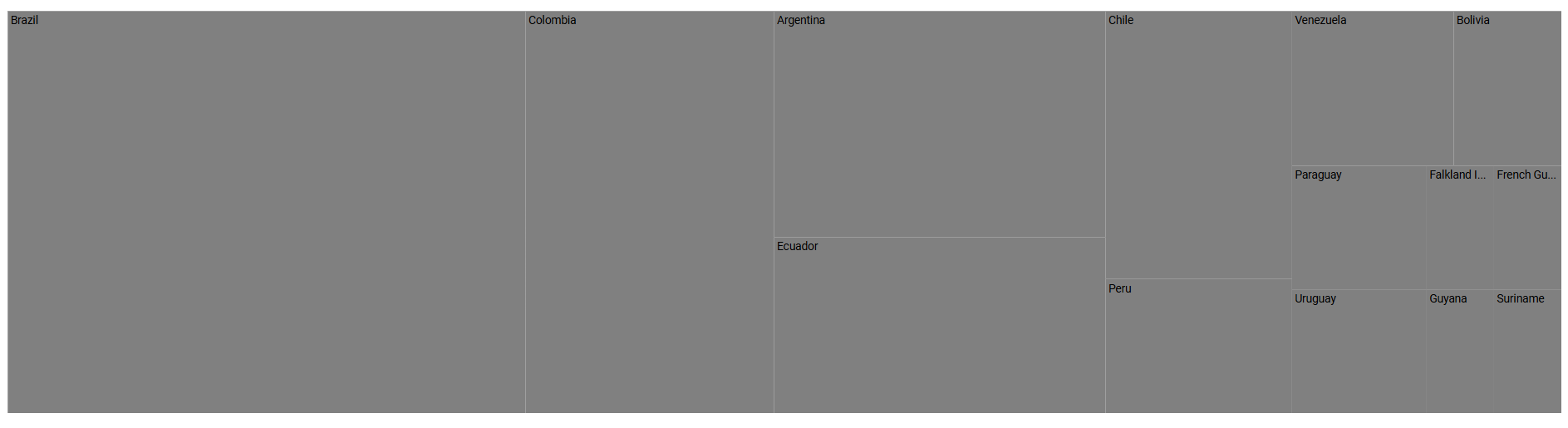
            { Title: 'State wise International Airport count in South America', State: "Brazil", Count: 25 },
            { Title: 'State wise International Airport count in South America', State: "Colombia", Count: 12 },
            { Title: 'State wise International Airport count in South America', State: "Argentina", Count: 9 },
            { Title: 'State wise International Airport count in South America', State: "Ecuador", Count: 7 },
            { Title: 'State wise International Airport count in South America', State: "Chile", Count: 6 },
            { Title: 'State wise International Airport count in South America', State: "Peru", Count: 3 },
            { Title: 'State wise International Airport count in South America', State: "Venezuela", Count: 3 },
            { Title: 'State wise International Airport count in South America', State: "Bolivia", Count: 2 },
            { Title: 'State wise International Airport count in South America', State: "Paraguay", Count: 2 },
            { Title: 'State wise International Airport count in South America', State: "Uruguay", Count: 2 },
            { Title: 'State wise International Airport count in South America', State: "Falkland Islands", Count: 1 },
            { Title: 'State wise International Airport count in South America', State: "French Guiana", Count: 1 },
            { Title: 'State wise International Airport count in South America', State: "Guyana", Count: 1 },
            { Title: 'State wise International Airport count in South America', State: "Suriname", Count: 1 },
        ],
        weightValuePath: 'Count',
        leafItemSettings: {
            labelPath: 'State',
        }
});
treemap.appendTo('#container');
The configuration uses the following properties:
-
dataSourcebinds the records displayed by the TreeMap. -
weightValuePathmaps the numeric field that determines each item’s area. -
leafItemSettingsconfigures leaf-item labels and appearance. -
labelPathmaps the field displayed as each leaf-item label.
The appendTo('#container') call renders the TreeMap in the HTML element whose ID matches the supplied selector.
Step 7: Run the Application
Run the following command from the project root:
npm run startWait for webpack to finish compiling the application. If the browser does not open automatically, open the local URL displayed in the terminal.
The project commonly runs at:
http://localhost:4000/The exact port can vary based on the webpack development-server configuration. To stop the development server, press Ctrl+C in the terminal.
Output
After completing the quick setup, the browser displays a TreeMap.
Module Injection
Basic TreeMap rendering and labels do not require feature-module injection. Inject optional modules only when their corresponding features are used.
-
TreeMapHighlightenables item highlighting. -
TreeMapSelectionenables item selection. -
TreeMapLegendenables legends. -
TreeMapTooltipenables tooltips.
Import TreeMap with the required modules and call TreeMap.Inject() before creating the component:
import {
    TreeMap,
    TreeMapHighlight,
    TreeMapLegend,
    TreeMapSelection,
    TreeMapTooltip
} from '@syncfusion/ej2-treemap';

TreeMap.Inject(
    TreeMapHighlight,
    TreeMapSelection,
    TreeMapLegend,
    TreeMapTooltip
);
Inject only the modules required by the application.
Troubleshooting
-
The repository cannot be cloned. Verify that Git is installed, confirm the internet connection, and run
git --version. -
npm installfails. Verify that Node.js and npm are installed by runningnode --versionandnpm --version. -
Cannot find module '@syncfusion/ej2-treemap'. Re-runnpm installfrom the project root. For a custom project, install the package withnpm install @syncfusion/ej2-treemap --save. -
The TypeScript application does not compile. Ensure that all Syncfusion packages use compatible versions and run
npm run buildto view the complete error. - The page is blank. Check the browser console for errors and confirm that webpack completed the build successfully.
-
The TreeMap is empty. Confirm that
dataSourcecontains records and thatweightValuePathmaps to a numeric field in every record.