Compatibility with Syncfusion® JS (Essential® JS 1)
20 Aug 20265 minutes to read
This article provides a step-by-step introduction to configuring the Essential® JS 1 and Essential® JS 2 JavaScript controls on the same web page.
Prerequisites
To use Essential® JS 1 and Essential® JS 2 controls together in JavaScript, the following system requirements must be met:
Creating a JavaScript application with the Essential® JS 2 control
1.You can create a JavaScript application with the help of the given Essential® JS2 getting started documentation.
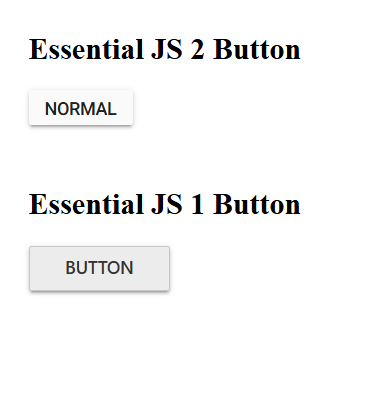
2.Now the Essential® JS 2 Button control rendered successfully in the web page.
Adding the Essential® JS 1 control to the JavaScript application
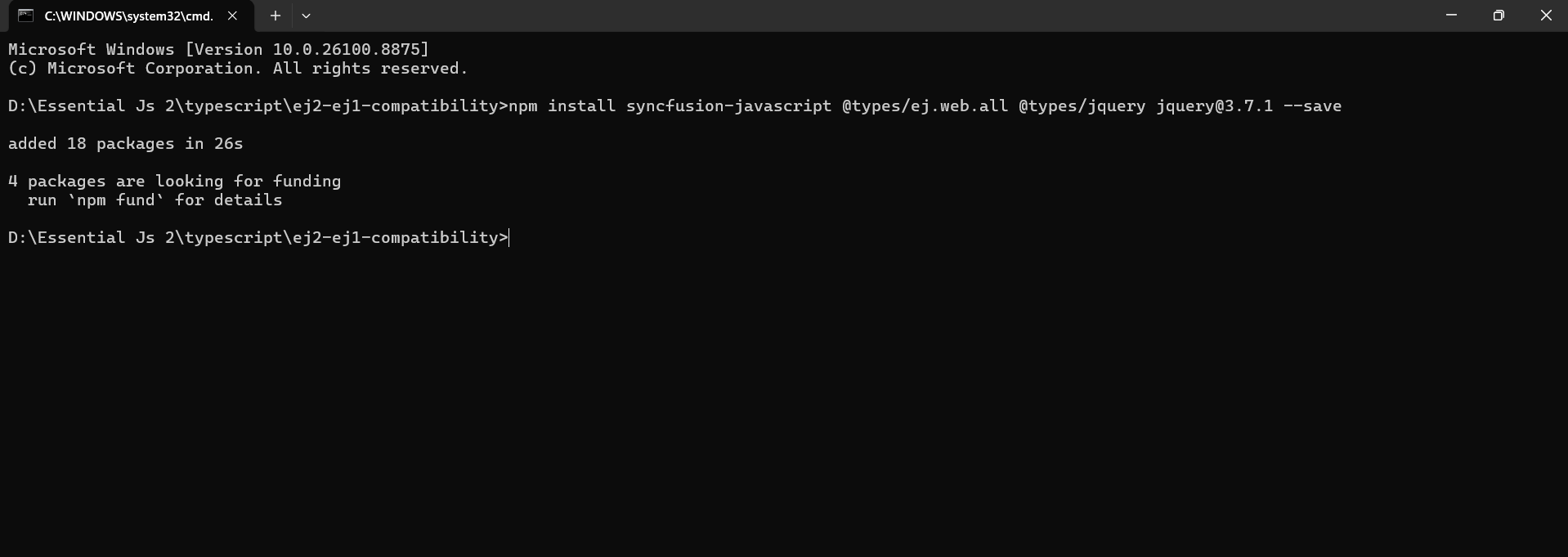
1.Install the Essential® JS 1 npm package with the required dependent typing package in the JavaScript quick start application.
npm install syncfusion-javascript @types/ej.web.all @types/jquery [email protected] --save
2.Add the HTML Button element inside the <body> element in the ~/src/index.html for rendering Essential® JS 1 Button control.
<head>
    .....
    .....
    <link href="http://cdn.syncfusion.com/16.1.0.24/js/web/flat-azure/ej.web.all.compatibility.min.css" rel="stylesheet" type="text/css" />

</head>
<body>
    ....
    ....

    <div style="margin: 50px;">
        <h2>Essential JS 2 Button</h2>
        <!--Essential JS 2 button-->
        <button id="ej2button">NORMAL</button>
    </div>
    <div style="margin: 50px;">
        <h2>Essential JS 1 Button</h2>
        <!--Essential JS 1 button-->
        <button id="button">BUTTON</button>
    </div>
</body>
Refer to this documentation to know more about Essential® JS 1 dependencies.
3.After adding the HTML Button element, Add the Essential® JS 1 compatibility style references in the styles.css file.
The compatibility styles of Essential® JS 1 and Essential® JS 2 must be added in the application to prevent the UI conflicts between the Essential® JS 1 and Essential® JS 2 controls.
Replace the style.css file content with the below style references.
@import '../../node_modules/@syncfusion/ej2/styles/compatibility/material.css';
4.Add the Essential® JS 1 type reference to the types compiler options in ~/tsconfig.json file.
{
    "compilerOptions": {
        "types": ["ej.web.all"]
    }
}
5.Expose jQuery on the global scope. The Essential® JS 1 bundle (ej.web.all.min.js) reads window.jQuery/window.$ directly, but webpack only ships jQuery as a module import. Create a new file ~/src/app/jquery-global.ts that imports jQuery and assigns it to window:
    import * as $ from "jquery";

    (window as any).$ = $;
    (window as any).jQuery = $;

    export {};
6.Register the jQuery global file as the first entry in ~/webpack.config.js so it runs before ej.web.all.min.js. Add webpack to the requires and add the ProvidePlugin so any module referencing the bare identifier jQuery/$ is automatically injected:
    const HtmlWebpackPlugin = require("html-webpack-plugin");
    const MiniCssExtractPlugin = require("mini-css-extract-plugin");
    const webpack = require("webpack");
    const path = require('path');

    module.exports = {
        entry: ['./src/app/jquery-global.ts', './src/app/app.ts', './src/styles/styles.css'],
        // ...rest of the config...
        plugins: [
            new HtmlWebpackPlugin({
                template: 'src/index.html'
            }),
            new MiniCssExtractPlugin({
                filename: "bundle.css"
            }),
            new webpack.ProvidePlugin({
                $: 'jquery',
                jQuery: 'jquery',
                'window.jQuery': 'jquery'
            })
        ],
    };
The
ProvidePluginis what makes the legacy Essential® JS 1 bundle work even if other code paths evaluateej.web.all.min.jsfirst.
7.Now, import the Essential® JS 1 script, jQuery, and the Essential® JS 2 Button, and create the Essential® JS 1 Button control in the ~/src/app/app.ts file.
    import "syncfusion-javascript/Scripts/ej/web/ej.web.all.min.js";

    import { Button as EJ2Button } from "@syncfusion/ej2-buttons";

    import $ from "jquery";

    declare const ej: any;

   // Render Essential JS 2 Button
    let ej2Button: EJ2Button = new EJ2Button({ content: "NORMAL" });
    ej2Button.appendTo("#ej2button");

   // Render Essential JS 1 Button
   $(function () {
       $("#button").ejButton({
           size: "medium",
           showRoundedCorner: true,
       });
   });
jQuery is made available on
windowby~/src/app/jquery-global.ts(the first webpack entry) and bywebpack.ProvidePlugin, so the legacyej.web.all.min.jsbundle can find it.
8.Finally, run the below command line and it will open the web application in the web browser.
npm start
The Essential® JS 1 and Essential® JS 2 Button control will be rendered in the same web page.